
Tissue embedding cassettes(also known as paraffin embedding cassettes or embedding cassettes) are essential consumables in histology and pathology laboratories. They hold tissue samples during processing, embedding, sectioning, and long‑term storage.
Huida’s embedding cassettes are made of high‑grade acetal copolymer (POM) , offering excellent resistance to organic solvents (xylene, alcohol, acetone) and paraffin. Key design features include:
● Secure lid with side slots for safe tissue retention and optimal fluid exchange
● Large labeling area (30° writing surface) for pencil, solvent‑resistant pen, or barcode
● Smooth, burr‑free edges to prevent tissue injury
● Compatible with automatic tissue processors and most microtomes
● Available in 11 colors (white, pink, blue, green, yellow, orange, purple, etc.) for color‑coding different tissue types or processing protocols.
Photo‑Sensitive vs. Standard Embedding Cassettes
| Feature | Standard Embedding Cassette | Photo‑Sensitive Embedding Cassette |
|---|---|---|
| Marking method | Inkjet, thermal transfer, or pencil | Laser marking (laser printer compatible) |
| Durability | Good, but ink may fade after prolonged exposure to solvents | Permanent – heat, solvent, and abrasion resistant |
| Barcode/QR code | Possible but may degrade over time | High‑contrast, permanent 2D codes for long‑term traceability |
| Price | Lower | Slightly higher (special surface coating) |
| Best for | Routine histology with short‑to‑medium storage | High‑throughput labs requiring long‑term archiving and automated identification |
Conclusion: Choose standard cassettes for daily routine work if cost is the main concern. Choose photo‑sensitive cassettes when you need permanent marking (e.g., clinical trials, research biobanks, or automated lab workflows).
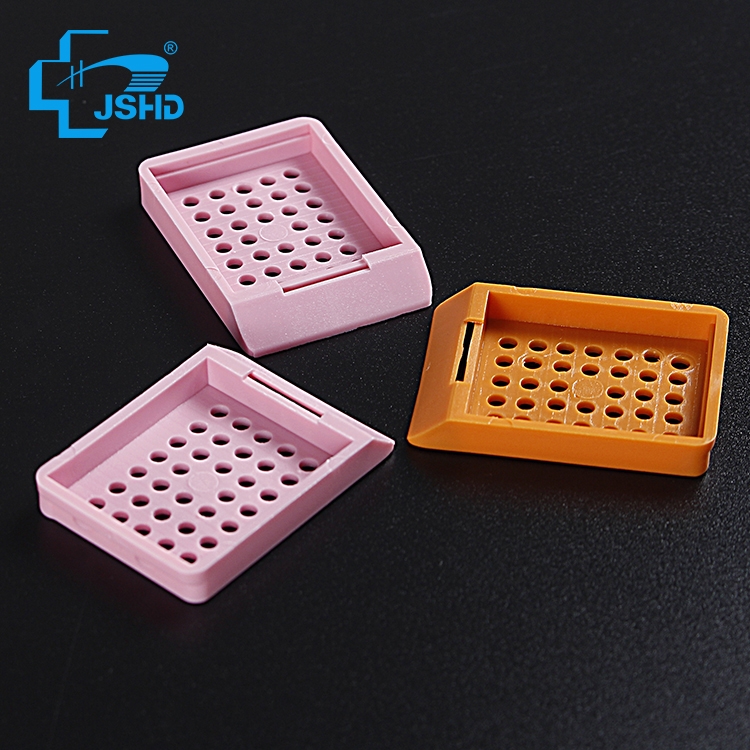
Specifications of Embedding Cassettes
| Specification | Details |
|---|---|
| Dimensions | 40 × 28 × 7 mm (external) |
| Hole design | 1.0 mm × 1.3 mm square holes; 15‑30% open area for uniform fluid flow |
| Lid type | Attached (integral hinge) or removable; front or side opening |
| Material | Acetal copolymer (POM) – resistant to all histology reagents |
| Color options | 11 standard colors |
| Writing surface | 30° slanted, frosted area |
| Printing compatibility | Standard: inkjet/thermal transfer printers; Photo‑sensitive: CO₂ / fiber laser markers |
| Sterilization | Non‑sterile (can be autoclaved at 121°C) |
Applications of Tissue Embedding Cassettes
Routine histopathology – Biopsy, resection, and autopsy tissue processing
Research laboratories – Animal and plant tissue embedding
Clinical trials – Traceable sample management with barcode/laser marking
Biobanks – Long‑term formalin‑fixed paraffin‑embedded (FFPE) tissue archiving
Industrial quality control – Food, cosmetic, or material sectioning
Both paraffin embedding cassettes and photo‑sensitive versions perform identically in these applications, except for the marking durability.
Why Choose Jiangsu Huida Medical Products?
Jiangsu Huida (Huida Medical) is a ISO 13485‑certified manufacturer with over 10 years of experience in pathology consumables. Our tissue embedding cassettes are produced in a dust‑free workshop with strict quality control (QC inspection before shipment). We offer:
Competitive factory prices – no middleman
Customizable options – colors, printing area, and packaging
Fast lead time – 15‑20 days for bulk orders
Consistent quality – passed independent biocompatibility testing
By choosing Huida, you reduce lab consumables cost without compromising diagnostic accuracy. Request a free sample to test our cassettes in your processor.
Frequently Asked Questions (FAQ)
Q1: Can I use photo‑sensitive embedding cassettes with a regular inkjet printer?
No. Photo‑sensitive cassettes require a laser marking system (e.g., CO₂ or fiber laser). For inkjet or thermal transfer printers, please choose standard embedding cassettes.
Q2: Are Huida embedding cassettes compatible with Leica, Thermo, Sakura, or Milestone tissue processors?
Yes. All Huida cassettes follow the international standard 40×28×7 mm dimensions and fit all major brands of tissue processors, embedding centers, and microtomes.
Q3: How should I store paraffin embedding cassettes before use?
Store in a cool, dry place away from direct sunlight and organic solvents. Do not exceed 50°C. The shelf life is 5 years under proper storage conditions.
Source & Reference
CLSI (Clinical and Laboratory Standards Institute) guideline QMS04 – Laboratory Consumables Management
Leica – “Tissue Processing and Embedding”
NCBI – “Specimen Processing in Histology”
Post time:2026-05-27


