
Histology Cassettes and Embedding Cassettes: Similar or Not?
If you have tried to find products under Embedding Cassettes, Histology Cassettes, or Tissue Cassettes for Histology, you are likely to find those terms used synonymously. This prompts an important question, popular among lab specialists, distributors and procurement officers:
Are Histology Cassettes and Embedding Cassettes the same thing?
In most cases, the answer to this question is yes. What we have here is largely a terminology, regional, or pathology workflow timestamp preference difference.
We will discuss below the different names and the reasons behind them, the similarities and differences that may or may not be commercially meaningful, and recommendations on where to purchase based on our decades of experience in the field.

The Invention Of Embedding Cassettes
In present day pathology, Tissue Cassettes are indispensable. This wasn’t always the case.
Prior to the 1950’s, gauze, filter paper, and cloth bags were used to wrap and hold tissue specimens during processing. These methods, although rather simple, were not without their challenges.
● Samples were easily lost.
● Labels would fall off or become unreadable.
● Organizing specimens was difficult.
● Sample throughput was low and rather inefficient.
Post WWII, the expanding pathology labs and the growing importance of cancer diagnosis created an urgent need for labs to be able to protect and identify tissue specimens.
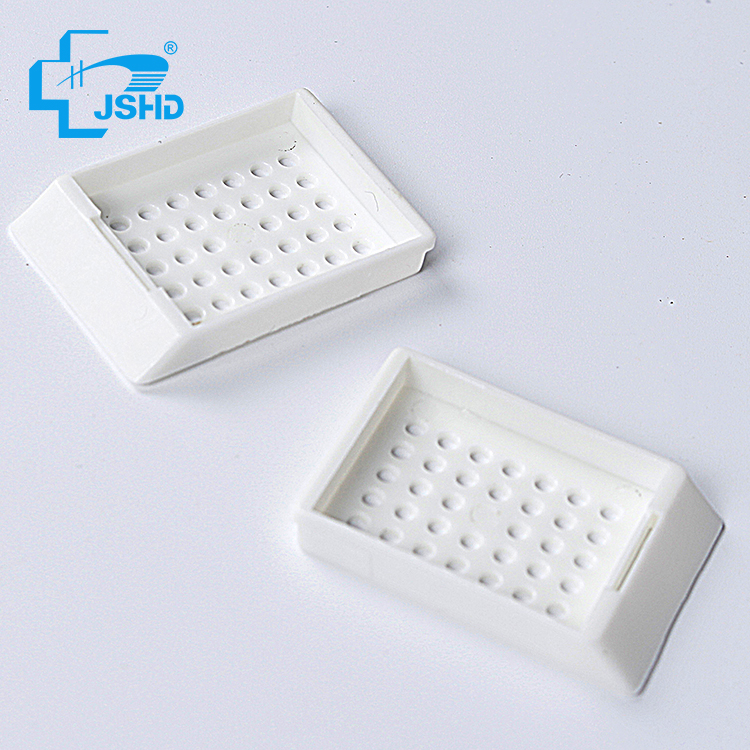
Plastic tissue cassettes arrived in the 1960s and 1970s with the following characteristics:
● Walls that were uniformly perforated.
● A lid that locked closed.
● A provided area for a specimen ID label that became permanent with the processing.
● A bottom that was rigid enough to allow embedding without having to remove the cassette.
The relatively simple design has allowed for specimen traceability and has greatly improved laboratory workflow and the reliability of diagnostics. The design has proven to be so versatile that tissue cassettes have now become a staple in histology laboratories around the world.
Histology Cassette vs Embedding Cassette: Similarities and Differences
Feature | Histology Cassette | Embedding Cassette |
Product structure | Same | Same |
Material | Medical-grade plastic | Medical-grade plastic |
Laboratory use | Histology & Pathology | Histology & Pathology |
Main emphasis | Histology workflow | Paraffin embedding stage |
Interchangeable | Yes | Yes |
Why Do Different Countries Use Different Terms?
Huida is a global manufacturer, supplying laboratories in over 100 countries. Because of our scope, we have determined that regional variation of terms is normal.
North America
● In the US and Canada, we most frequently hear:
● histology cassette
● tissue cassette
● tissue cassettes for histology
These terms are used in pathology labs, hospitals, and universities.
Europe
In the embedding process, cassettes become a critical element of paraffin. So, European customers tend to use:
● embedding cassette
● tissue cassette
Australia and New Zealand
The terms histology cassette and embedding cassette are both readily accepted.
Asia, the Middle East, Africa, and Latin America
Importers and distributors generally use the terms that appear in the local laboratory or purchasing documentation.
International suppliers can tailor their offerings to the regional vocabulary to improve their communications and search relevance.
Which Cassette Is Better for Biopsy?
This is a common question.
For tissue cassettes used for processing small biopsy tissue, cassettes with more perforations are often preferred.
Products must have a secure lid, along with appropriately sized perforations, dependable specimen identification, and design that works with automated tissue processors. Buyers should look at design for small tissue specimens rather than the product name for cassettes.
Which Cassette is Better for Routine Pathology?
For routine surgical pathology, histology or embedding cassettes are truly the same, thus are interchangeable.
Routine pathology labs value:
● Processing speed
● Ease of automation
● Consistent sizing
● Excellent paraffin adhesion
● Durable labeling surfaces
The quality of the manufacturer is likely more important than the name of the product.
Purchasing Tips for Laboratory Buyers
When purchasing tissue cassettes for histology, a purchase manager should look beyond cost.
Assess the:
● Medical grade polymer that is chemically resistant
● Consistent size for automation
● Easy locking design
● Smooth surface for laser or ink printing
● Clear specimen identification
● Good batch to batch consistency
● Multiple color options
Compatibility with the most used tissue processors and embedding workstations
Well designed cassettes can reduce processing errors and improve lab efficiency.
Why choose Huida for your Histology Cassette?
Huida's over 20 years in the pathology consumable manufacturing industry ensures quality. Our embedding and histology cassettes have been used by hospitals and diagnostic labs, our products are used by universities and sold by distributors, and our business works with many OEM partners.
We have
● Manufacturing Experience
● Pathology and Laboratory Expertise
● Every batch of products is put through box quality control for the locking system and material control testing to ensure reliable performance in your lab.
● Global OEM & ODM Services
For our international distributors, we offer tailored options for colors, logos, packaging, and labeling.
● Extensive Product Line
Huida doesn’t just provide histology tissue cassettes. Our product line also includes microscope slides, cover glass, staining jars, embedding molds, specimen containers, and additional pathology consumables.
● Global Business Experience
Our products are sold and are actually being used in Europe, North America, South America, Asia, the Middle East, and Africa.

FAQ:
Q: Is there a difference between histology cassettes and embedding cassettes?
A:Most pathology labs consider histology and embedding cassettes to be the same. Cassettes are used to hold tissues during the steps of fixation, processing, embedding, and sectioning. The differences are typically regional or from specific suppliers, and not based on a difference in function of the product. Nomenclatures such as histology cassettes or embedding cassettes may be used interchangeably. Size and compatibility of the cassettes with your tissue processor should be confirmed before you make a purchase.
Q: How do I select a tissue cassette for my lab?
A:There is no one-size-fits-all when it comes to selecting the ideal tissue cassette. The following should be considered based on the specific type of specimen and on the workflow in your lab:
● The features of your tissue processor and embedding systems
● The style of lid: either detachable or integral
● The design: either biopsy or routine
● The material, which should be chemical resistant medical grade plastic
● The surface: either smooth writing or a surface to facilitate barcode printing
● Colors to facilitate specimen identification
Q: Are histology cassettes all compatible with automatic tissue processors?
A:Most histology cassettes are compatible with the majority of automated tissue processors offered by the leading manufacturers. There is, however, a great deal of variation among suppliers with regard to dimensions, perforation, lid locking mechanisms, etc. To ensure reliable protection of your specimens and smooth processing, these variations should be reconciled with the equipment in your lab before purchasing a cassettes in bulk.
Conclusion
Are histology cassettes and embedding cassettes actually the same?
Most likely, yes, in the vast majority of laboratories.
The variation is primarily in how the terms are used. While the histology cassette is used to refer to the discipline of the laboratory, the embedding cassette is used to refer to the embedding process of paraffin. Knowing both terms will enable laboratories to interface with suppliers worldwide and will guarantee that the purchaser will get the appropriate product regardless of the terminology used in the region.
It doesn’t matter if you are searching for embedding cassettes, histology cassettes, or tissue cassettes for histology. What really counts is that you choose the right and reliable manufacturer with quality assurance, global experience, and constant production and delivery to guarantee the cassettes will enable you to have a reliable and seamless pathology workflow.
Post time:2026-07-28


