
When buying disposable gloves, there are many factors to consider. The main three types, latex, vinyl, and nitrile gloves, compared on protection, comfort and cost. The best disposable glove for you depends on the environment you are in and the chemicals you may come into contact with, as well as how long you plan to use the gloves and your budget.
Although all three types of disposable gloves provide hand protection, they greatly differ in composition, strength and flexibility among others. Knowing the differences, as well as vinyl vs nitrile gloves, is helpful for medical providers, labs, food vendors and suppliers.
What are Latex Gloves?
Latex gloves are made from rubber latex, which has great flexibility and elasticity and offers great hand fit and comfort for the user.
This is why latex gloves have historically been the go to for medical and dental exam and lab gloves.
Pros of Latex Gloves
Great elasticity and fit
Comfortable and fit
Sensitively Measure Touch
Good resistant for many short medical contaminations
Cons of Latex Gloves
Latex allergy are at the top of the list of concerns.
Some gloves users may feel some irritation, and prolonged contact may cause itching or a full-blown allergic reaction.
Because of this, many hospitals and labs have taken to use other disposable gloves, such as nitrile.
Recommended Applications:
Medical examination
Dental treatment
Laboratory research
Healthcare procedures requiring high sensitivity
What Are Vinyl Gloves?
Vinyl gloves are made with polyvinyl chloride (PVC), or PVC gloves. Among disposable gloves, they are very economical and are selected for the applications where many changes are needed.
Vinyl gloves have less elasticity than latex and nitrile gloves and are a cost-effective solution for general protection.
Advantages of Vinyl Gloves:
Cost-effective solution
The main advantage of using vinyl gloves is their low price. Industries using large amounts of disposable gloves, such as food processing, cleaning, and healthcare, can use them to greatly reduce costs.Latex-free and skin friendly
Because vinyl gloves don’t have natural rubber latex, they can be used by those with a sensitivity to latex.Easy to wear and remove
The loose fitting of vinyl gloves allows them to be easily and quickly worn and removed, which is important in those environments where quick changes of gloves are needed.
Limitations of Vinyl Gloves:
Compared with nitrile gloves, vinyl gloves have:
Less tensile strength
less elasticity
less resistance to chemicals
less protection for long-term use
For these reasons, they should not be used for high risk medical procedures and for use in strong chemical environments.
Recommended Applications:
Food handling
Cleaning services
Beauty salons
Laboratory general handling
Low-risk medical examination
What Are Nitrile Gloves?
Nitrile gloves are made with synthetic nitrile rubber and are a popular alternative to latex gloves.
Nitrile gloves are now more popular than latex gloves in healthcare and manufacturing, laboratories, and even in the field of pharmaceuticals, due to their toughness and resistance to chemicals.
Benefits of Nitrile Disposable Gloves:
High Protection Performance
Nitrile gloves are tougher and resistant to puncturing more so than latex and vinyl gloves and are less likely to tear during use.
Excellent Chemical Resistance
Nitrile disposable gloves are resistant to many chemicals and solvents and provide excellent protection for laboratory and industrial work.
Latex Free
Nitrile gloves are a great option for protection for those who are sensitive to latex, as there are no natural latex proteins in the construction of these gloves.
Comfortable
Modern nitrile gloves are made with increased ergonomics and flexibility.
Drawbacks of Nitrile Gloves:
More expensive than vinyl gloves
Slight loss of tactile sensitivity when compared to latex gloves
Not appropriate for specialized chemical use
Ideal Uses:
Hospital and clinic use
Laboratory work
Pharmaceutical work
Chemical work
Medical use
Latex Gloves vs Vinyl Gloves vs Nitrile Gloves: Key Differences Comparison
| Feature | Latex Gloves | Vinyl Gloves (PVC Gloves) | Nitrile Gloves |
|---|---|---|---|
| Material | Natural rubber latex | Polyvinyl chloride (PVC) | Synthetic nitrile rubber (NBR) |
| Material Source | Natural rubber extracted from rubber trees | Synthetic plastic polymer | Petroleum-based synthetic rubber |
| Elasticity | Excellent | Low to moderate | Excellent |
| Hand Fit | Very comfortable and close-fitting | Loose fit | Comfortable ergonomic fit |
| Touch Sensitivity | Excellent | Moderate | Very good |
| Puncture Resistance | Good | Lower | Excellent |
| Chemical Resistance | Moderate | Limited | Excellent |
| Latex Allergy Risk | Possible | No | No |
| Durability | Good | Basic | High |
| Long-Term Wearing Comfort | Good | Limited | Excellent |
| Cost Level | Medium | Lowest | Higher |
| Best Application | Medical examination, dental, precision work | Food handling, cleaning, low-risk tasks | Healthcare, laboratories, pharmaceutical, chemical handling |
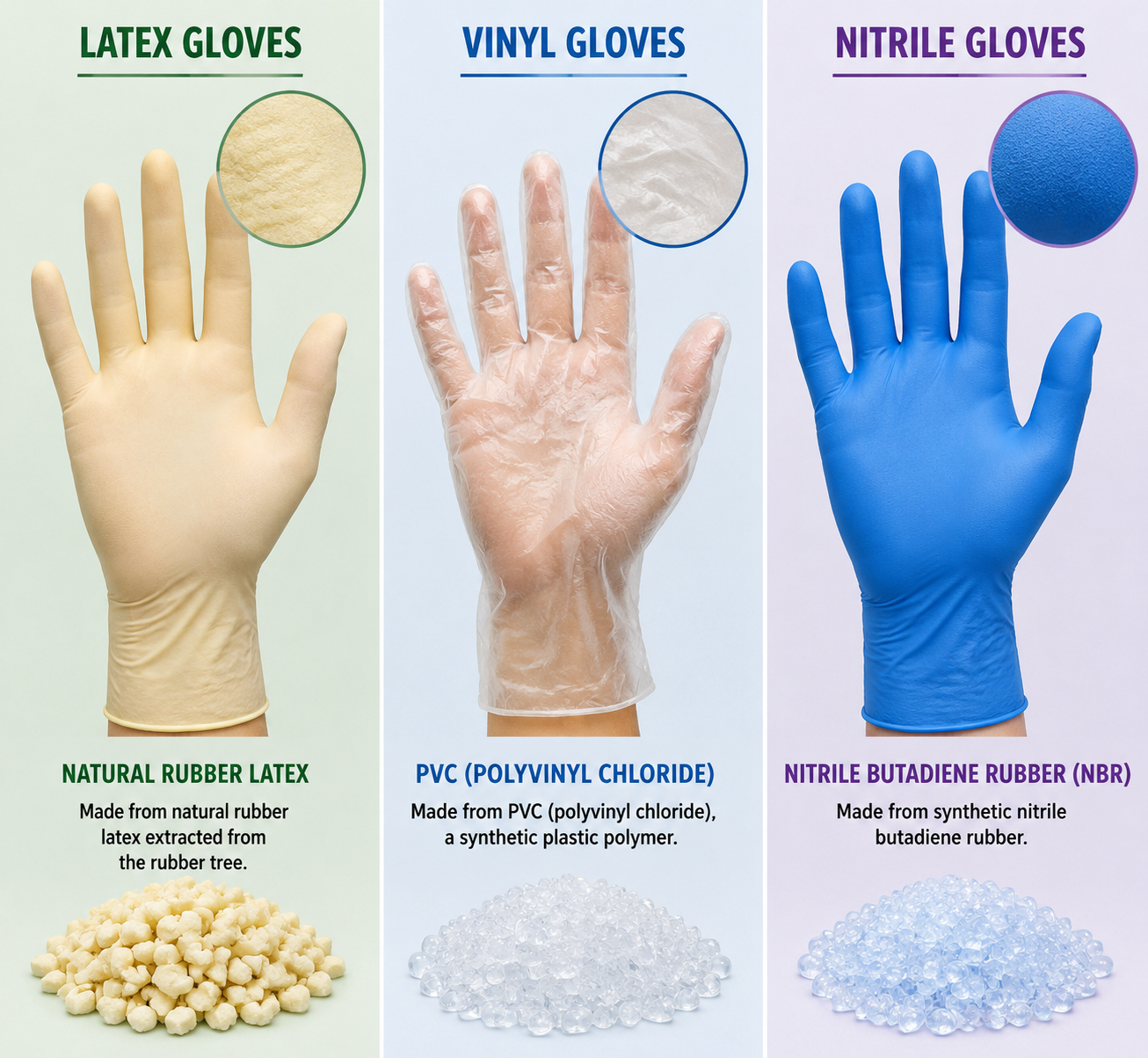
When purchasing disposable gloves the buyer must take multiple things into account.
Application Risk
Vinyl gloves are good for low risk applications such as food preparation, general cleanup, and basic examinations. For laboratory and medical applications and for dealing with chemicals, nitrile disposable gloves are ideal.
Time Used
Nitrile gloves are recommended for applications that require the gloves to be worn for several hours because they are more flexible. Vinyl gloves are better for cost when dealing with applications that require the gloves to be frequently changed throughout the task.
Cost
Vinyl gloves are ideal for large volume applications such as factories. The cost for nitrile gloves is justifiable for the added protection for hospitals and labs.
Shipping and Purchasing
Disposable gloves are packed in boxes that take up a lot of space. Because of this, shipping costs will depend on how many boxes are ordered, the destination, and how the order will be shipped. Bulk orders will usually have better shipping costs due to the use of container shipping. Selecting a reliable medical disposable glove manufacturer with good production capability will help decrease supply risks.
Which are the Better Gloves?
There are a lot of things to take into account when determining the best disposable glove for the application.
Vinyl gloves are a good value for low risk application. Latex gloves are good for applications that require sensitivity but can cause allergic reactions.
FAQ 1: Are vinyl gloves better or worse than nitrile gloves in a medical setting?
While there are certain medical situations where vinyl gloves are suitable, in most situations, they are not comparable to nitrile disposable gloves. Nitrile disposable gloves have superior strength and resistance to punctures and chemicals. For procedures where there is exposure to blood, body fluids or chemicals, disposable nitrile gloves are preferred by most hospitals, labs, and healthcare workers. Disposable vinyl gloves are preferred in low-risk situations because of their lower cost.
FAQ 2: What is the difference between disposable nitrile gloves and latex gloves?
The main difference between the two is their material. Disposable latex gloves are made from natural rubber whereas disposable nitrile gloves are made from rubber of synthetic nitrile. Because nitrile gloves are made without latex, they are the best option for people that have a latex allergy. Additionally, nitrile gloves have superior resistance to punctures and many chemicals. On the other hand, latex gloves are better for tasks that require more flexibility and tactility.
FAQ 3: In what situations should I choose vinyl gloves over nitrile disposable gloves?
Vinyl gloves should be used in situations where choosing the lowest cost option is more important than the risk associated with the job. They are most commonly used in food prep, cleaning, beauty, and medical services where a routine examination is performed, and gloves are changed frequently. If any of the situations described above involve the use of chemicals or infectious materials, or if the gloves are meant to be used for a long period of time, then disposable nitrile gloves should be used.
FAQ 4: Are nitrile disposable gloves resistant to chemicals?
Yes. Nitrile disposable gloves have exceptional resistance to oils, greases, solvents, and many lab chemicals. Their use is prevalent in pharmaceutical manufacturing and labs, as well as in the automotive industry and healthcare. It should be noted, though, that no glove material has complete resistance to all chemicals. Therefore, it is good practice to consult the glove manufacturer’s chemical compatibility list pertaining to the intended use of the gloves.
FAQ 5: Which disposable gloves should be purchased in bulk for the best value?
From a wholesale, hospital, distributor, or bulk purchasing perspective, the best value in disposable gloves would depend on the intended use for the gloves. For high-volume, low-risk applications, vinyl gloves would likely be the best value due to lowest unit price. For other applications, disposable nitrile gloves can provide a better value due to lower failure rate, longer life cycle, and improved safety. In these scenarios, the purchasing price of the gloves should be considered with the price of freight and the anticipated costs associated glove failure to achieve the best value.
Post time:2026-08-03


