
Welcome To Huida
Multi-Sample Needles
Multi-sample needles — also known as double-ended blood collection needles or multiple-use drawing needles — are the standard phlebotomy device used with evacuated tube systems. One end penetrates the patient's vein; the other, protected by a self-sealing rubber sleeve, pierces the stopper of a vacuum blood collection tube. This design allows multiple tubes to be filled from a single venipuncture, reducing patient discomfort and improving workflow efficiency in hospitals, clinical laboratories, and blood banks.
Huida Medical supplies a complete range of multi-sample needles in all standard gauges and lengths, with both conventional and safety-engineered models available for wholesale and OEM distribution.
How Multi-Sample Needles Work
The multi-sample needle is designed to be screwed into a standard tube holder (barrel). Once the needle is in the vein, the phlebotomist inserts an evacuated collection tube into the holder. The rear needle pierces the tube stopper, and blood flows automatically under vacuum pressure.
When one tube is full, it is removed and another can be inserted. The rubber sleeve at the rear of the needle automatically reseals between tube changes, preventing blood leakage. This is the key feature that makes "multi-sample" collection possible.
Procedure summary:
Screw the needle into a compatible tube holder
Remove the outer cap and perform venipuncture
Put the first vacuum tube — blood flows automatically
Swap tubes as needed; the sleeve reseals each time
Withdraw the needle and dispose of it in a sharps container
The Specification Of Multi-Sample Needles
| Gauge | Needle Length | Hub Color | Outer Diameter | Recommended Use |
|---|---|---|---|---|
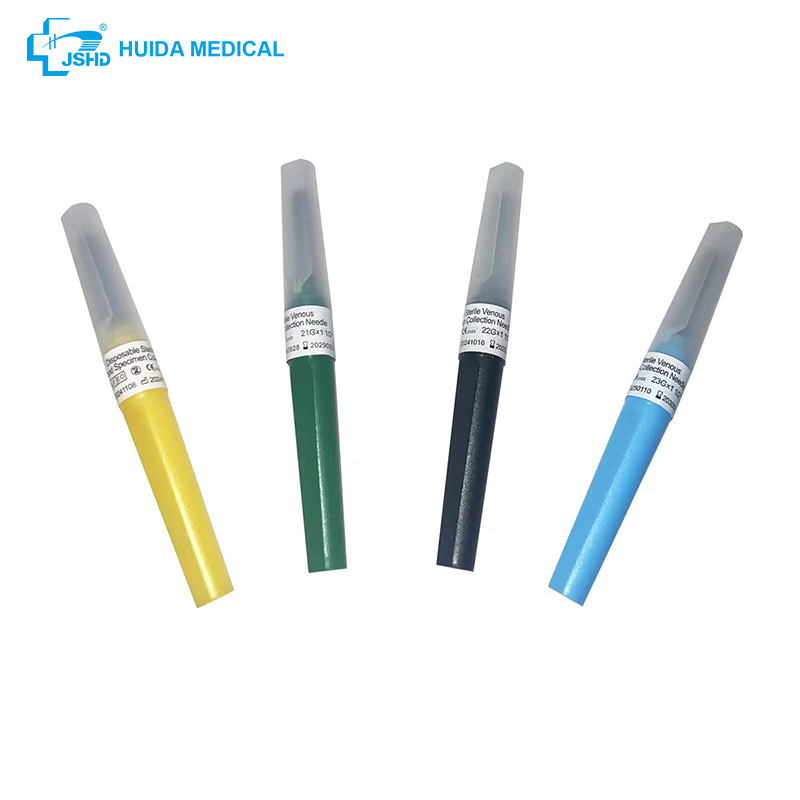
| 18G | 1" / 1¼" / 1½" | Pink | 1.2 mm | Blood donation, large-volume draws |
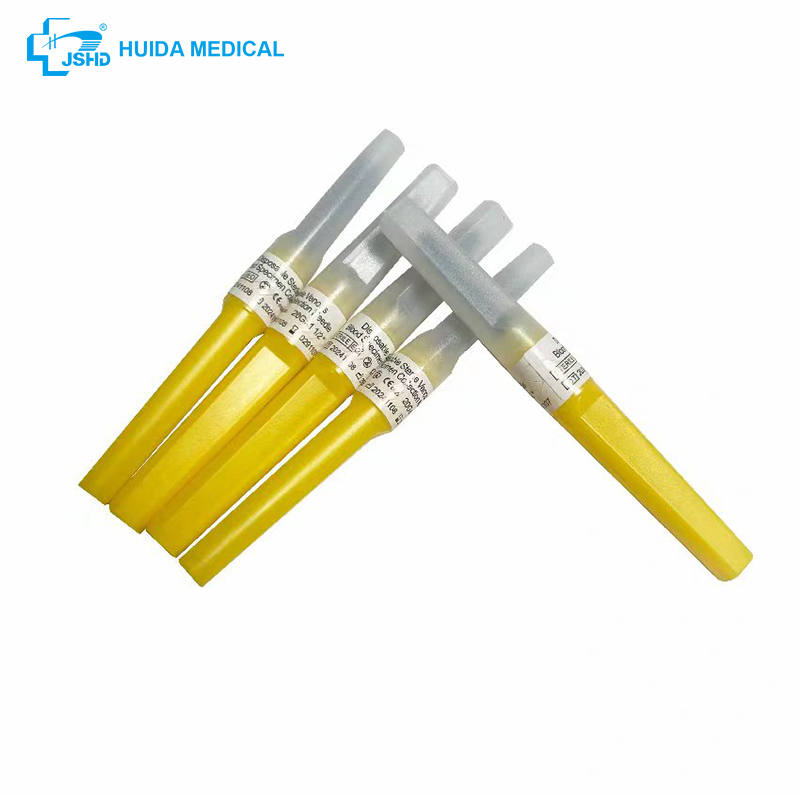
| 20G | 1" / 1¼" / 1½" | Yellow | 0.9 mm | Routine adult venipuncture, blood bank |
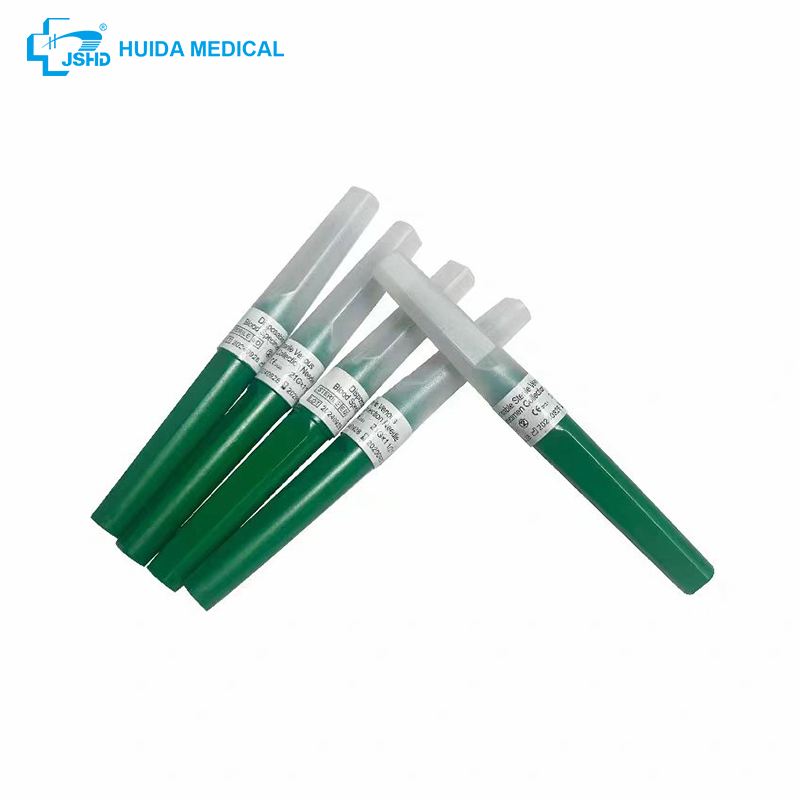
| 21G | 1" / 1¼" / 1½" | Green | 0.8 mm | Most widely used — standard hospital & lab draws |
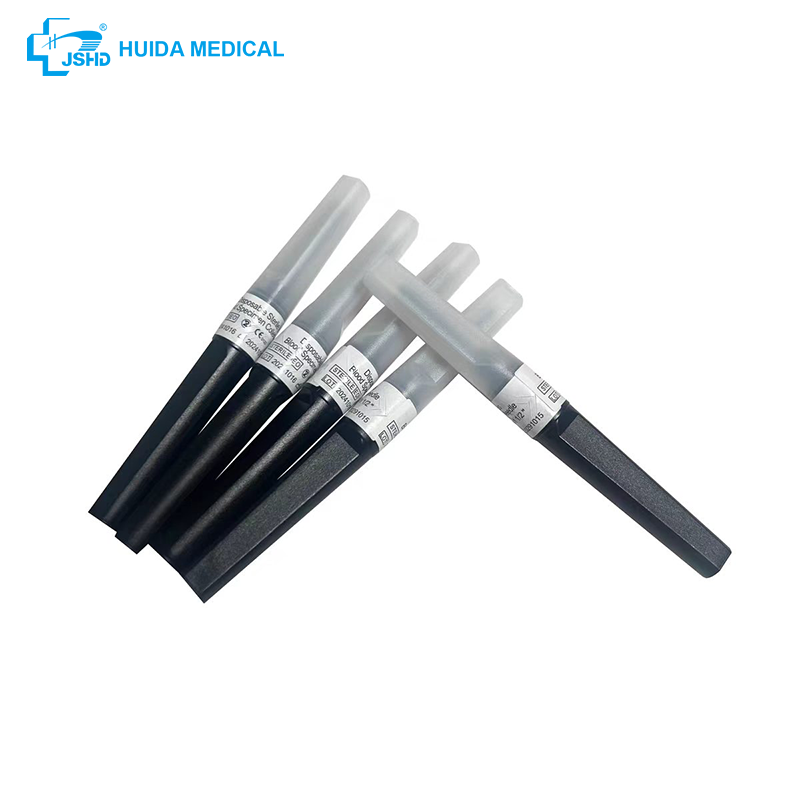
| 22G | 1" / 1¼" / 1½" | Black | 0.7 mm | Pediatric, geriatric, small or fragile veins |
| 23G | 1" / 1¼" / 1½" | Blue | 0.6 mm | Neonates, pediatric, difficult-access patients |
How to Choose the Right Gauge
Selecting the correct gauge balances blood flow rate, sample quality, and patient comfort.
18G (Pink): The largest standard gauge. Used primarily for blood donation, apheresis, and rapid transfusion-related draws. Not recommended for routine outpatient phlebotomy.
20G (Yellow): Suitable for adult patients with well-defined, accessible veins. Commonly used in emergency departments and blood banks.
21G (Green): The global default gauge for routine venipuncture. Provides adequate flow rate while minimizing patient discomfort. Accounts for the majority of hospital and laboratory collections.
22G (Black): Preferred for elderly patients, children, and individuals with small or rolling veins. Blood should be drawn at a moderate pace to avoid hemolysis.
23G (Blue): The smallest standard gauge. Used for neonates, pediatric patients, and extremely difficult venous access. Slow, controlled draw is essential to prevent sample hemolysis.
Needle length selection:
1" (25 mm): Standard length for most adult patients
1¼" (32 mm): Versatile all-purpose length — our most stocked option
1½" (38 mm): Recommended for obese patients or deep veins
Safety Multi-Sample Needles
Accidental needlestick injuries expose healthcare workers to bloodborne pathogens such as HIV, hepatitis B, and hepatitis C. Huida Medical's safety multi-sample needles feature an integrated shielding mechanism that activates immediately after withdrawal.
Safety features:
One-handed activation with a simple finger push
Audible click confirms the shield is locked
Fully enclosed contaminated needle tip — no re-exposure possible
Compatible with all standard tube holders
Conforms to ISO 23908 sharps injury protection requirements
Safety models are available in 21G (green) and 22G (black). Many healthcare facilities now mandate safety-engineered devices under occupational health regulations, including EU Council Directive 2010/32/EU and OSHA Bloodborne Pathogens Standard (29 CFR 1910.1030).
Applications Of Multi-Sample Needles
Hospital inpatient and outpatient phlebotomy departments
Clinical laboratories and diagnostic centers
Blood banks and transfusion services
Pediatric and neonatal units
Long-term care facilities and nursing homes
Mobile blood donation campaigns
Veterinary clinics (selected gauges)
Why Choose Huida Medical?
As a professional medical device manufacturer, Huida Medical supplies multi-sample needles to distributors, hospitals, and laboratory chains worldwide.
Complete size range — 18G through 23G, all three lengths, in stock for immediate shipment
OEM & private label — custom branding, packaging, and hub colors available for volume orders
Quality assurance — automated production with 100% needle-point inspection; full batch traceability
Regulatory compliance — CE marked, ISO 13485 certified factory, complete technical documentation provided
Flexible terms — FOB Shanghai, CIF, or DDP; mixed-gauge orders accepted
Free samples — available for qualified buyers (freight collect)
FAQ:
Q1:What is the difference between a multi-sample needle and a butterfly needle?
A multi-sample needle is a rigid, double-ended needle that screws directly into a tube holder for vacuum blood collection. A butterfly needle (winged infusion set) has a small needle with flexible plastic wings and thin tubing, connected to a luer adapter or syringe. Multi-sample needles are faster and cheaper for routine multi-tube draws, while butterfly needles offer better control for small, fragile, or difficult-to-access veins.
Q2:Can a butterfly needle be used for multiple blood collection tubes?
Yes. When fitted with a multi-sample luer adapter, a butterfly needle can be used with evacuated vacuum tubes just like a standard multi-sample needle. However, you should always draw a discard tube first to clear air from the tubing and ensure proper fill ratios for additive tubes (e.g., citrate, EDTA).
Q3:Which needle is less painful — multi-sample or butterfly?
Pain level depends primarily on gauge size rather than device type. A 21G multi-sample needle and a 21G butterfly needle feel similar on insertion. However, butterfly needles are more commonly used in smaller gauges (23G, 25G) and have shorter needle lengths, which many patients — especially children — report as less painful.
Which needle is less painful — multi-sample or butterfly?
Can a butterfly needle be used for multiple blood collection tubes?
What is the difference between a multi-sample needle and a butterfly needle?
How to Choose the Right Gauge
18G (Pink): The largest standard gauge. Used primarily for blood donation, apheresis, and rapid transfusion-related draws. Not recommended for routine outpatient phlebotomy.
20G (Yellow): Suitable for adult patients with well-defined, accessible veins. Commonly used in emergency departments and blood banks.
21G (Green): The global default gauge for routine venipuncture. Provides adequate flow rate while minimizing patient discomfort. Accounts for the majority of hospital and laboratory collections.
22G (Black): Preferred for elderly patients, children, and individuals with small or rolling veins. Blood should be drawn at a moderate pace to avoid hemolysis.
23G (Blue): The smallest standard gauge. Used for neonates, pediatric patients, and extremely difficult venous access. Slow, controlled draw is essential to prevent sample hemolysis.
1" (25 mm): Standard length for most adult patients
1¼" (32 mm): Versatile all-purpose length — our most stocked option
1½" (38 mm): Recommended for obese patients or deep veins


WHY CHOOSE US
Since its establishment, our factory has been developing first world
class products with adhering the principle
of quality first. Our products have gained excellent reputation in the industry and
valuabletrusty among new and old customers..
- Tel:86-515-88387981
- Qingfeng industrial park, yandong, yancheng, jiangsu, China
- sales@chinahuida.cn


Tips - Featured Products - Sitemap
Lab Microscope Slide, China Surgical Suture, Plastic Labware, Laboratory Glasswares, Microscope Slides, Laboratory Glassware, All Products