
Welcome To Huida
Glass Staining Jar for Microscope Slides | Histology & Pathology Laboratory | Huida Medical
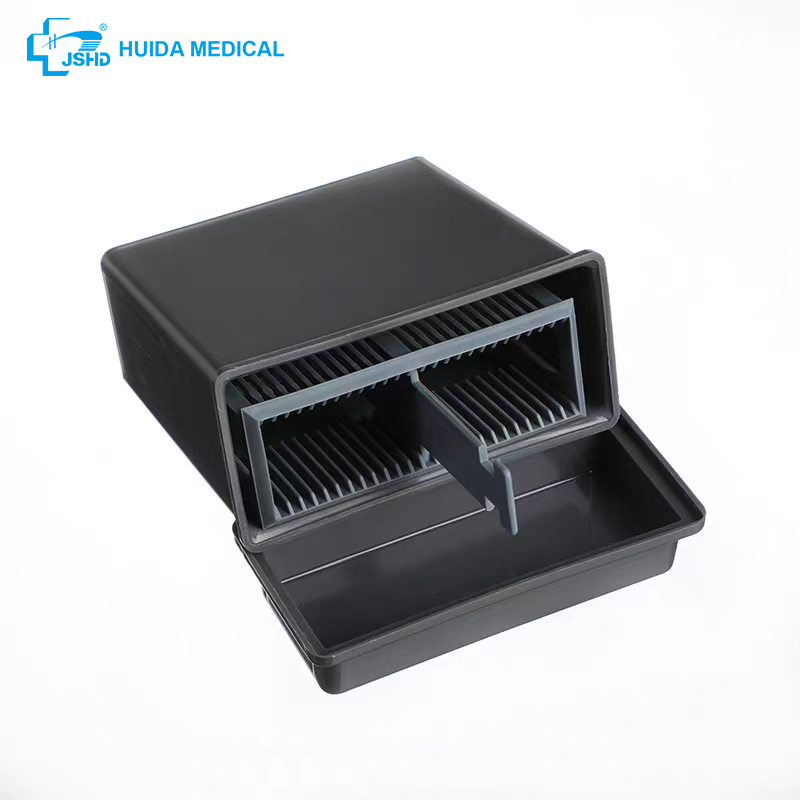
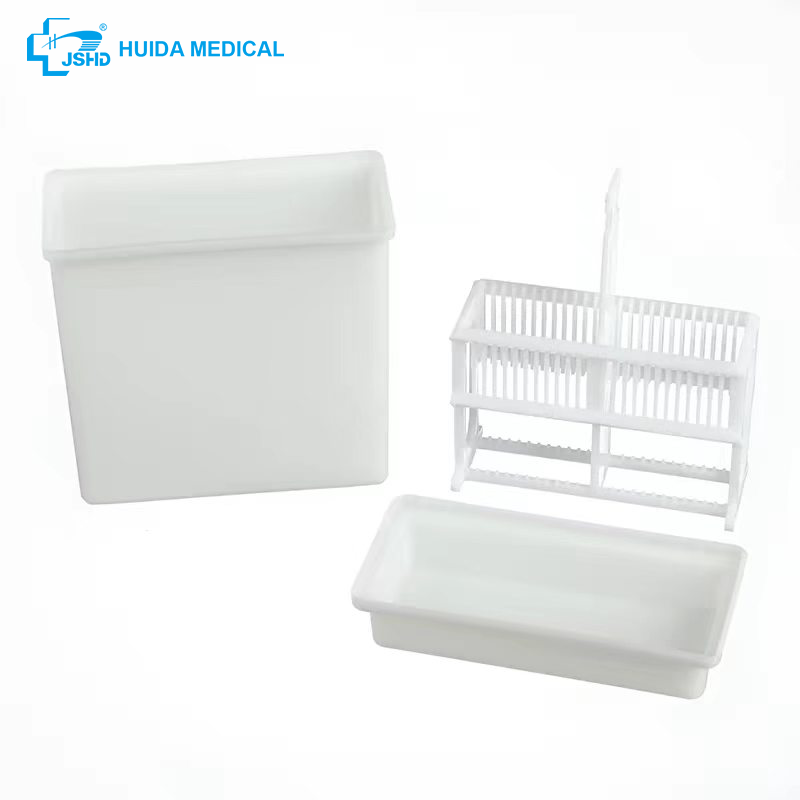
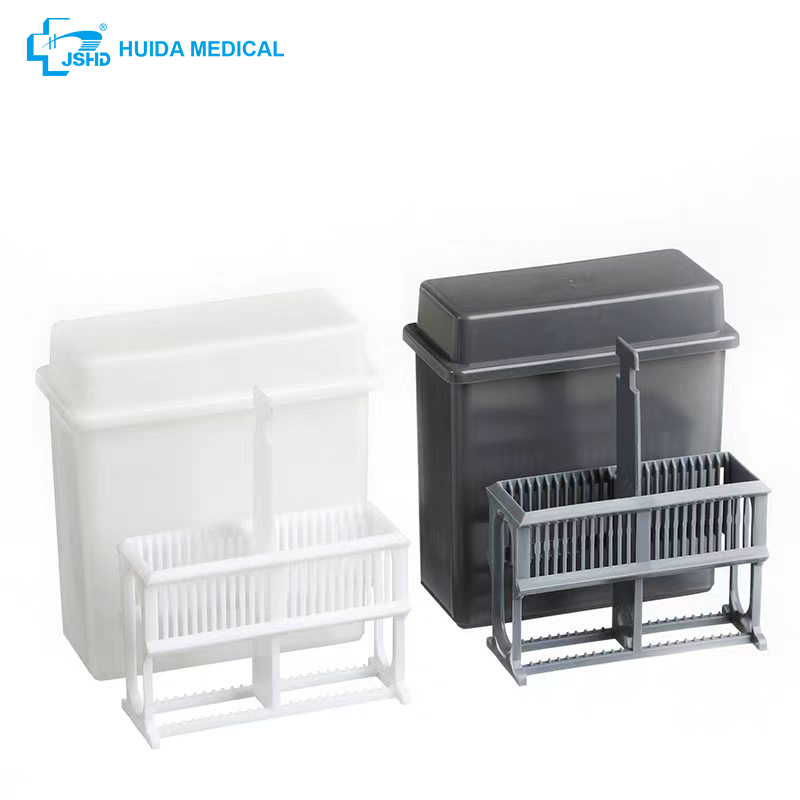
Glass Staining Jar for Microscope Slide Staining
Slide preparation in histology and cytology combines both science and art. Among the many components of the microscope slide preparation process is the staining jar, which is crucial yet often overlooked. The quality of staining jars impacts staining clarity, which influences the accuracy of diagnoses of researchers, pathologists, and laboratory technicians.
The goal of this article is to examine the details of the premium Staining Jar for Microscope Slides from Jiangsu Huida Medical Instruments Co., Ltd. We will study the jars, how they function and their advantages over traditional Coplin style jars, the range of their purposes, and why they are the primary jars used in the best laboratories.
the specification Of Staining Jar
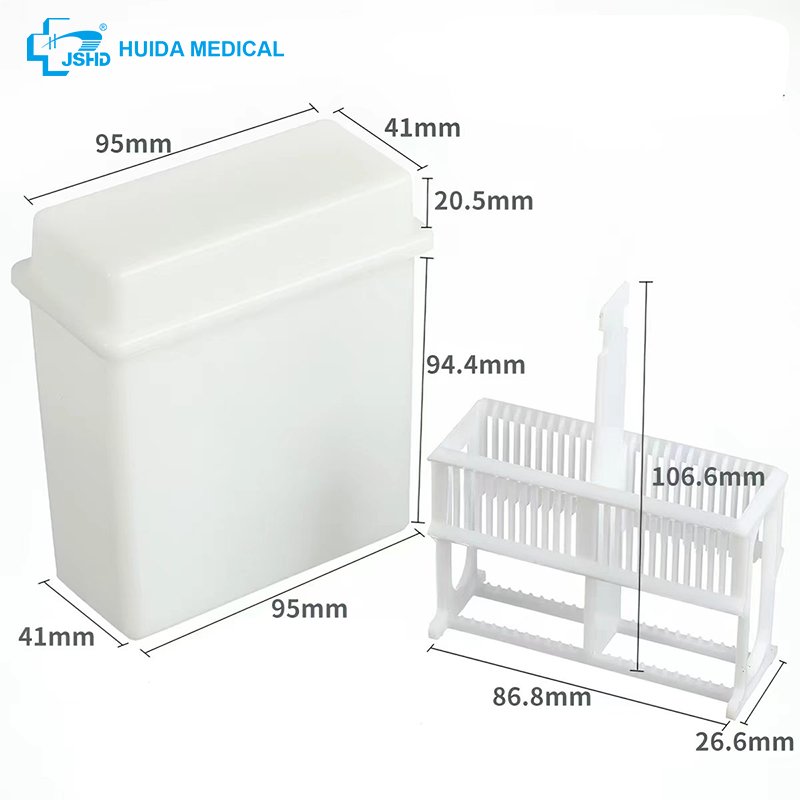
| Code No. | Description | Specification | Material |
| HP4001 | Staining Jar and Rack | For 24 Pieces of slides | PP |
The “Invent” Of Staining Jar
Staining jars immerse microscope slides in various reagents and chemicals such as Hematoxylin, Eosin, and alcohol for varying periods of time.
Users design jars with grooves to simplify vertical slide loading and placement of staining solutions. Staining jars are designed so that slides, which are 75mm in length, are completely submerged, but still allow the slide to be removed (typically with tweezers) from the top of the jar. This design technique is called "vertical immersion" and it maximizes and ensures uniform staining of all samples. This design technique also helps with sample reproducibility.
How to Use The Staining Jar Correctly
To ensure best practice when using your HUIDA MEDICAL Staining Jar, please follow these instructions:
Preparation: Ensure slides are fixed (e.g. methanol).
Loading: Transfer slides to the empty jar. If multiple slides are used, load them back to back, tissue sides out, to protect the sample.
Immersion: Add staining solution to the jar until slides are fully covered.
Incubation: Leave slides in the jar for the specified duration (e.g. different solutions for Giemsa staining require exact timing).
Succinct Processing: Transfer slides (often with forceps) to a series of other jars containing different reagents (e.g. for dehydration and clearing: water, alcohol, xylene).
Cleaning: After use, clean the jar thoroughly. If a lid is used, ensure the jar is dry before storage to avoid contamination.
Comparison: Staining Jar vs. Coplin Staining Jar
| Feature | Staining Jar (General Purpose) | Coplin Staining Jar |
| Design | Often features a wider mouth and a taller design; slides usually stand upright inside the jar. | Typically has a narrower, more standardized rectangular base. |
| Handling | Slides often extend above the opening for easy manipulation without forceps. | Usually requires forceps for manipulation if slides are deep inside. |
| Lid Type | Often comes with a ground glass or polypropylene screw cap to reduce evaporation. | Similar options, but often designed with a specific screw cap that may be removed during use to avoid damaging slides. |
| Versatility | The “Staining Jar” terminology often covers a broader range of styles, including "Hellendahl"or general vertical jars. | A very specific design that guarantees a precise fit for standard slides, maximizing reagent efficiency (usually requiring less liquid). |
| Application | Ideal for protocols where slides need to be dipped or where a larger volume is beneficial. | Ideal for batch staining where you have exactly 5 or 10 slides and want to conserve reagents. |
Key Takeaway: While the Coplin is a specific type of staining jar, the HUIDA MEDICAL Staining Jar offers a design that prioritizes accessibility and ease of use, making it exceptionally user-friendly.
Applications Of The Staining Jar
Histology: Staining of tissue with H & E (Hematoxylin & Eosin) for tissue morphology.
Cytology: Giemsa and Diff-Quik staining of blood smears and fine needle aspirates.
Microbiology: Bacterial and fungal stains, and Gram stain.
Research: Various cellular stain and IHC (Immunohistochemistry) steps.
Why Jiangsu Huida Medical
Jiangsu Huida Medical Instruments Co., Ltd. has been a leading company in the medical and laboratory supplies for over 20 years. Set up in 2003, we are a specialized, national high-tech enterprise which focuses on pathology consumables and laboratory glassware.
Our reputation depends on our Staining Jars' certified excellence. We strive to ensure that Staining Jars are subject to the true international standards of excellence, from the CE mark to the registrations of the FDA and other certification authorities. All our Staining Jars are guaranteed to be accurate and pure.
Also, the flexibility and dedication we exhibit towards our OEM and ODM services ensure the true customization for the requirements of your laboratories. Our state-of-the-art facilities with more than 12,000 square meters with the capability to produce and export more than 98% of our products to the international market, positioning Huida as a truly reliable partner.
Products are shipped in robust cartons with foam inserts to ensure that even with the roughest of handling, the products reach customers as they should.
Frequently Asked Questions (FAQ)
Q: How many slides does the Staining Jar hold?
A: Staining jars can hold 5 slides if placed vertically, or 10 slides if placed back to back. The slides are the standard size of 25 x 75 mm (3" x 1").
Q: Can Staining jars be autoclaved?
A: Staining jars are made of glass and should withstand the autoclaving process. The plastic cover should be removed before autoclaving.
Q: What is the recommended cleaning process for staining jars?
A: Residual Stains can be removed from staining jars using ethanol or xylene followed by a wash of deionized water. If stubborn residual stains are present, these can be removed using a glass cleaner.


WHY CHOOSE US
Since its establishment, our factory has been developing first world
class products with adhering the principle
of quality first. Our products have gained excellent reputation in the industry and
valuabletrusty among new and old customers..
- Tel:86-515-88387981
- Qingfeng industrial park, yandong, yancheng, jiangsu, China
- sales@chinahuida.cn


Tips - Featured Products - Sitemap
Lab Microscope Slide, China Surgical Suture, Plastic Labware, Laboratory Glasswares, Microscope Slides, Laboratory Glassware, All Products