
Welcome To Huida
Disposable Urine Bags
What Are Disposable Urine Bags?
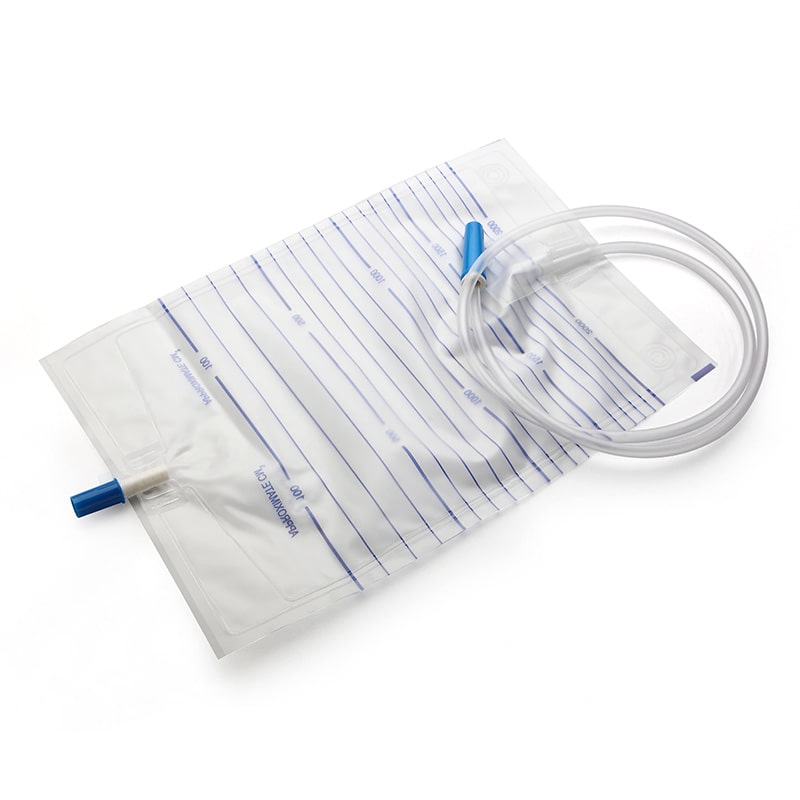
Disposable urine bags — also called drainage bags, urinary collection bags, or urinating bags — are single-use medical devices designed to collect and measure urine output from patients with indwelling urinary catheters, suprapubic catheters, or condom catheters. Made from medical-grade PVC film, each bag features a calibrated measurement scale, a flexible connecting drainage tube, and a secure outlet mechanism that allows caregivers to empty the bag without disconnecting the catheter system.
Standard disposable urine bags are manufactured in three common capacities — 1000 ml, 1500 ml, and 2000 ml — and sterilized by ethylene oxide (EO) gas to ensure sterility for single-patient use. The graduated markings printed on the bag (in 100 ml increments) enable accurate fluid output monitoring, which is essential for clinical assessment of hydration status, renal function, and postoperative recovery. The bottom outlet design allows safe, hygienic drainage of collected urine, reducing the risk of contamination and catheter-associated urinary tract infections (CAUTIs).
Advantages and Disadvantages of Disposable Urine Bags
Advantages
Infection control: Single-use, EO-sterile packaging eliminates cross-contamination between patients, a critical factor in hospital infection prevention.
Accurate measurement: Clear graduated markings allow precise monitoring of urine output — essential for critical care, surgery recovery, and renal patients.
Hygienic emptying: Bottom outlet taps enable drainage without disconnecting the closed catheter system, reducing infection risk.
Anti-reflux protection: Most models include an anti-reflux chamber or valve that prevents urine backflow into the bladder, lowering CAUTI risk.
Convenience: Lightweight, pre-connected, and ready to use — no assembly required, saving nursing time.
Cost-effective: Disposable construction eliminates reprocessing, sterilization, and laundry costs associated with reusable systems.
Disadvantages
Environmental impact: PVC single-use products generate medical waste that requires proper disposal.
Limited capacity: A 2000 ml bag requires emptying every 8–12 hours for high-output patients, which may disrupt rest.
Cost over time: Frequent replacement accumulates cost compared to reusable alternatives for long-term home use.
Material sensitivity: Some patients may react to PVC materials; DEHP-free options are available as alternatives.
Single-use only: Not designed for reprocessing — attempting sterilization and reuse compromises safety.
Product Types and Specifications
Jiangsu Huida manufactures a full range of disposable urine bags to match different clinical needs. The complete specification is available in the accompanying product type sheet.
Model | Product Type | Capacity | Outlet | Anti-Reflux | Best For |
A-1000 | Bottom Outlet Urine Bag | 1000 ml | Drainage Tap | Yes | Routine adult bedside care |
A-1500 | Bottom Outlet Urine Bag | 1500 ml | Drainage Tap | Yes | Overnight / high-output patients |
A-2000 | Bottom Outlet Urine Bag | 2000 ml | Drainage Tap | Yes | ICU, prolonged drainage |
C-750 | Urinary Leg Bag | 750 ml | Drainage Tap | Yes | Ambulatory & wheelchair patients |
D-500 | Pediatric Urine Bag | 500 ml | Drainage Tap | No | Neonatal & pediatric wards |
All models are EO gas sterilized, individually packed, and feature printed graduated measurement marks for accurate monitoring.
Common Use Cases
Disposable urine bags are used across a wide range of healthcare settings:
Hospitals and Wards: Postoperative drainage monitoring, urinary retention management, and routine catheter care.
ICU and Critical Care: Precise hourly urine output tracking for shock, sepsis, and renal failure patients.
Home Healthcare: Long-term catheter patients who require daily drainage bag changes at home.
Nursing Homes and Aged Care: Assisted toileting for elderly residents with mobility or continence issues.
Ambulatory Care: Leg bag models for active patients who need freedom of movement during the day.
Pediatric Care: Smaller-capacity bags designed for infants and children in pediatric wards.
Why Choose Jiangsu Huida Medical Instruments?
Jiangsu Huida Medical Instruments Co., Ltd. is a trusted manufacturer of disposable urine bags and medical consumables with over 20 years of experience. Operating from a 12,000 m² facility in Yancheng, China, with dedicated cleanroom production, Huida maintains strict quality control from raw material to finished product.
Every batch of urine bags is manufactured under certified quality management systems: ISO 9001 for general quality management and ISO 13485 specifically for medical devices. Products carry CE marking for the European market and maintain FDA establishment registration for the United States. These internationally recognized certifications ensure that our disposable urine bags meet global safety and performance standards — giving distributors, hospitals, and homecare providers full regulatory confidence.
With competitive factory pricing, reliable lead times, and export experience across 100+ countries, Huida is your dependable partner for bulk procurement of sterile urine bags and related medical consumables.
FAQ
Q1: How often should a disposable urine bag be changed?
A: For optimal infection control, most clinical guidelines recommend changing a standard bedside urine bag every 5–7 days, or immediately if the bag becomes soiled, damaged, or contaminated. Leg bags used during the day should typically be changed every 24–48 hours. Always follow your facility's infection control protocol.
Q2: What is the difference between a bedside urine bag and a urinary leg bag?
A: Bedside drainage bags (1000–2000 ml) are larger, designed to hang from the bed frame and collect urine overnight or for extended periods. Urinary leg bags (typically 500–750 ml) are smaller, strapped to the calf or thigh, and allow patients to walk and move freely during the day. Many patients use a leg bag by day and a larger bedside bag at night.
Q3: Are these urine bags sterile and suitable for catheter use?
A: Yes. All Huida disposable urine bags are sterilized by ethylene oxide (EO) gas and individually sealed in sterile packaging. They are designed for use with indwelling Foley catheters, suprapubic catheters, and external condom catheters. The anti-reflux design and bottom outlet help maintain a closed drainage system, which is essential for reducing catheter-associated urinary tract infections.
WHY CHOOSE US
Since its establishment, our factory has been developing first world
class products with adhering the principle
of quality first. Our products have gained excellent reputation in the industry and
valuabletrusty among new and old customers..
- Tel:86-515-88387981
- Qingfeng industrial park, yandong, yancheng, jiangsu, China
- sales@chinahuida.cn


Tips - Featured Products - Sitemap
Lab Microscope Slide, China Surgical Suture, Plastic Labware, Laboratory Glasswares, Microscope Slides, Laboratory Glassware, All Products