In every gynecological clinic, hospital, women's health center, family planning clinic, and obstetric practice around the world, the vaginal speculum is more than a piece of equipment — it is the gateway to accurate diagnosis, effective screening, early cancer detection, safe contraceptive care, and routine women's health maintenance. Yet despite its universal presence in routine healthcare, the choice between reusable metal and disposable plastic speculums, between different shapes, sizes, materials, and brands, remains a procurement decision that directly affects patient comfort, clinical outcomes, infection control compliance, and the operational cost structure of every facility that uses them.
A French vaginal speculum is a specific design variant distinguished by its characteristic duckbill-shaped blades, ergonomic hinged frame, and color-coded ratchet fastener system. Unlike the Cusco (bivalve) speculum commonly associated with North American practice, the French speculum design offers a narrower profile, a longer barrel, and a more tapered atraumatic tip — features that clinicians across Europe, Francophone Africa, the Middle East, and large parts of Asia and Latin America have long preferred for patient tolerance and precise cervical visualization. Today, the disposable plastic version of this classic design has become the global standard, replacing reusable stainless steel speculums in the majority of new clinics, refurbished hospitals, and public health programs.
This comprehensive guide is written for purchasing managers at hospitals, gynecologists, clinic administrators, infection control practitioners, medical device distributors, and national procurement agencies who need a complete, authoritative, and professionally written reference on disposable French vaginal speculums. Whether you are sourcing a plastic disposable speculum for a single outpatient clinic, equipping a women's health center, restocking a hospital network, or expanding your distribution catalog, this article covers everything you need: product anatomy, the full speculum size chart, material science, E.O. sterilization protocols, step-by-step usage guidance, clinical use cases with scenario photography, quality certification requirements, sizing selection logic, bulk procurement verification, and a clear explanation of why a disposable plastic speculum from Jiangsu Huida delivers superior clinical and economic value over generic alternatives.
Search volume data shows that procurement teams, clinicians, and distributors regularly search for terms including disposable French speculum, plastic vaginal speculum, speculum sizes chart, disposable speculum manufacturer, French speculum vs Cusco, and sterile disposable speculum wholesale. This guide is structured to answer all of those queries in one authoritative resource, so that your website becomes the trusted destination for buyers evaluating speculum suppliers in the medical device B2B space.
By the end of this guide, you will understand exactly which speculum size to order for each patient population, what specifications to verify with your manufacturer before bulk purchase, how the color-coding system reduces clinical selection errors, what regulatory documents to request, and what questions to ask before placing your first purchase order. Let us begin with the fundamentals.
2. A Brief History: From Ancient Specula to Modern Disposable Plastic
The vaginal speculum is one of the oldest known surgical instruments. Archaeological evidence from ancient Greece and Rome shows that specula were used as early as the 4th century BCE, with bronze and silver instruments found in Roman medical sites across Europe and the Mediterranean. The French physician Ambroise Paré documented refined speculum designs in the 16th century, and by the 19th century, the French speculum design — characterized by its duckbill blades and hinged frame — had been standardized across European medical practice. The name "French speculum" itself reflects the origin of this design tradition in French medical education and instrument manufacturing.
The 20th century brought stainless steel as the dominant material, enabling autoclave sterilization and durable reuse. For most of the century, metal speculums were the only option. The shift to disposable plastic began in the 1970s, driven by the HIV/AIDS crisis and a broader recognition that reprocessing reusable instruments carried measurable cross-infection risk. By the 1990s, single-use plastic speculums were widely adopted in hospitals across the United Kingdom, Scandinavia, and the WHO's family planning programs in developing countries. Today, disposable speculums account for the majority of speculum volume globally, with the French design dominating European, Asian, Middle Eastern, and Latin American markets.
The modern Huida disposable French speculum represents the culmination of this design evolution: precision injection-molded from medical-grade transparent polymer, E.O. gas sterilized to SAL 10^-6, color-coded for rapid size identification, and engineered for single-use safety — all at a price point that makes high-quality disposable care accessible to clinics of every budget level.
3. What Is a Disposable French Vaginal Speculum?
3.1 Clinical Definition and Purpose
A vaginal speculum is a medical instrument inserted into the vagina to gently widen the vaginal canal and expose the cervix for direct visual examination, sample collection, or minor instrumental procedures. The French vaginal speculum — also known in some markets as the Sims-style or duckbill speculum — is composed of two parallel blades joined at a hinged base, with an adjustable ratchet mechanism that holds the blades open at a chosen, clinician-selected width.
In its disposable plastic form, the instrument is injection-molded from medical-grade transparent polystyrene (PS), fitted with a color-coded polypropylene (PP) ratchet fastener. It arrives in an individual sterile peel-pouch, having been sterilized by ethylene oxide (E.O. gas) to a Sterility Assurance Level (SAL) of 10^-6. After a single patient use, the entire unit is discarded as regulated medical waste — eliminating washing, inspection, packaging, and autoclaving steps that reusable metal speculums require between every patient.
The core clinical purposes of a French vaginal speculum include: visual inspection of the vaginal walls and cervix during routine pelvic examination; collection of cytology samples (Pap smear), cervical biopsies, and microbiology swabs; performance of colposcopy with magnification and illumination; insertion and removal of intrauterine devices (IUDs); application of topical diagnostic or therapeutic solutions; assistance during minor gynecological procedures; and postpartum or post-operative assessment of the cervix and vaginal vault.
3.2 Structural Anatomy of the French Speculum
To make an informed purchasing decision, procurement buyers and clinicians benefit from understanding the structural components of a disposable French vaginal speculum:
Upper and Lower Blades (Duckbill): The two flattened, parallel plates that enter the vagina. The French design features a longer, narrower blade profile compared to the Cusco speculum, which tends to be shorter and wider. The blade tips are rounded and smooth to minimize mucosal trauma and patient discomfort. The transparent material allows both direct line-of-sight examination and, when needed, illumination from a colposcope or endoscopy light source to pass through the blade walls. The inner blade surface is designed to be smooth and non-adherent, preventing collection of discharge or cervical mucus that could obscure the view.
Hinge Pivot: The joint at the base where the two blades meet. In disposable plastic speculums, this is a living hinge or pin hinge molded as an integrated part of the plastic frame. The hinge must operate smoothly without binding or wobbling, and it must withstand the opening and closing cycle during a single procedure without cracking, crazing, or deforming. Cheaply manufactured speculums often fail at the hinge — a structural weak point that can cause the instrument to lock open unexpectedly or snap during withdrawal.
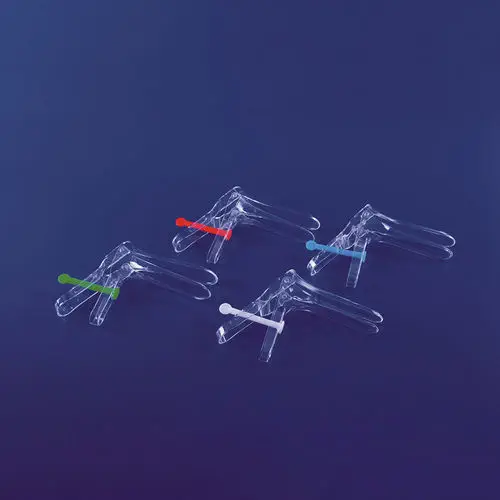
Ratchet Fastener (Color-Coded): The adjustable locking mechanism that holds the blades at a fixed opening width. The fastener slides along a toothed track on the handle, clicking into preset positions (typically five positions on Huida units). On Huida's French speculums, the fastener color identifies the size: Yellow for XXS, White for XS, Blue for S, Red for M, and Green for L. This color-coding system allows clinical staff to identify the speculum size at a glance — even during an active procedure — reducing selection errors and improving overall workflow efficiency in busy outpatient settings.
Handle / Grip: The portion held by the clinician during insertion and adjustment. The French design places the ratchet track along the lower handle, giving the operating hand natural access to the locking mechanism while the other hand stabilizes the outer blade. The handle geometry is designed to be grasped comfortably with sterile examination gloves, without sharp edges or flash from the molding process.
Finger Rest / Thumb Lever: The portion of the frame that the clinician squeezes to close the blades for insertion and withdrawal. This lever must provide enough mechanical advantage for easy operation while being robust enough to handle repeated squeezing without deformation.
3.3 French vs. Cusco vs. Graves: Design Differences Explained
Speculum design varies by regional preference, and understanding the differences helps you source the correct instrument specification for your target market:
French (Duckbill) Speculum: Characterized by a longer, narrower blade with a tapered, rounded tip. Preferred across Europe, Francophone Africa, the Middle East, and parts of Asia and Latin America. The narrow profile is generally better tolerated by patients with a narrow vaginal introitus, virginal patients, adolescents, and post-menopausal women with vaginal atrophy. The longer barrel provides deeper visualization for procedures requiring stable cervical access. Huida manufactures exclusively this design.
Cusco (Bivalve) Speculum: The most common design in North America. Features shorter, wider blades that open in an elliptical shape. The wider opening can be advantageous for collecting large cervical samples or accommodating bulky instruments, but may cause more discomfort in patients with narrow vaginal openings. The Cusco design also tends to cast more shadow inside the vaginal canal due to its opaque metal or thick plastic construction.
Graves Speculum: A wider, longer variant of the bivalve design, typically used for multiparous women and obstetric examinations. It is the largest standard speculum size and is rarely appropriate for nulliparous, adolescent, or petite patients. The Graves design is popular in American obstetrics but uncommon in French-influenced markets.
If your clinic, distributor network, or target export market spans Europe, Asia, the Middle East, Africa, or Latin America, the French disposable plastic speculum is the correct product specification to source. If you primarily serve the North American market, you will likely want to add Cusco-sized units to your catalog in addition to the French range.
3.4 Why the Global Shift from Reusable Metal to Disposable Plastic?
For most of the twentieth century, vaginal speculums were made of stainless steel, designed to be sterilized between patients in autoclaves. While reusable metal speculums are durable and offer some tactile advantages, they carry significant drawbacks that have driven the global transition to single-use plastic alternatives — a trend accelerated by the COVID-19 pandemic and broader infection control regulation:
Cross-Contamination Risk: Reusable instruments must be thoroughly cleaned and sterilized between every patient. Breakdowns in reprocessing workflow — incomplete washing, autoclave cycles that do not reach the required temperature, water spots, dried biological material on the hinge — create a documented risk of cross-infection, including transmission of HPV, chlamydia, gonorrhea, and other pathogens. The WHO and national health regulators have increasingly recommended single-use instruments where clinically equivalent alternatives exist, particularly in outpatient settings with high patient throughput.
ReproProcessing Labor and Cost: Washing, enzymatic soaking, inspection, packaging, and autoclaving reusable speculums consumes significant nursing and sterile-processing labor, plus water, energy, and autoclave maintenance costs. For high-throughput clinics performing dozens of pelvic examinations per day, the cumulative cost of reprocessing often exceeds the purchase price of a disposable plastic speculum by a factor of two or three.
Patient Comfort: Cold metal speculums are a well-known source of patient anxiety and physical discomfort. Disposable plastic speculums are at room temperature instantly when removed from their pouch, and the rounded atraumatic tips reduce mucosal friction. Many patients specifically report less discomfort with modern plastic speculums compared to recalled metal instruments, which has a measurable effect on screening attendance rates.
Administrative and Audit Cost: Reusable instrument programs require ongoing quality control documentation: autoclave log records, biological indicator testing, instrument traceability, and periodic inventory of which instruments have been reprocessed how many times. The disposable speculum eliminates this entire administrative burden because every unit arrives pre-sterilized and traceable by LOT number.
For modern procurement teams today, the infection control, workflow efficiency, and patient experience benefits of the disposable plastic speculum decisively outweigh the alternatives in nearly all outpatient gynecological applications.
4. Product Types: The Complete Speculum Size Chart
Huida's disposable French vaginal speculums are manufactured in five standardized sizes, designated XXS, XS, S, M, and L. Each size is distinguished by a color-coded ratchet fastener, allowing instant visual identification at any point during a procedure. The following table summarizes the full product range. A downloadable, fully searchable Excel version of this product type catalog is also available as a companion spreadsheet, containing dimensional specifications, recommended patient profiles, packaging details, and certification information.
Size | Fastener Color | Typical Blade Length | Max Opening | Patient Profile | Primary Use Case |
|---|
XXS | Yellow | ~65 mm | ~12 mm | Pediatric, pre-menarchal girls | Pediatric gynecology, trauma follow-up |
XS | White | ~75 mm | ~15 mm | Adolescent, petite adult | Adolescent screening, young patients |
S | Blue | ~85 mm | ~18 mm | Average slender adult | Routine exam, Pap smear, young adult |
M | Red | ~95 mm | ~22 mm | Average adult (most common) | General gynecology, colposcopy, IUD |
L | Green | ~105 mm | ~26 mm | Large-build, obstetric, post-menopausal | Obstetric exam, postpartum care, multiparous |
Related resource: The complete product type catalog — including material specifications, sterilization parameters, packaging details, and the full color-coding reference — is organized in a dedicated Excel/Feishu Sheet that can be filtered, sorted, and printed as a purchase specification sheet. Access it here:
Disposable French Vaginal Speculum Product Types Catalog.
4.1 Size XXS (Yellow Fastener)
The XXS is the smallest French speculum in the Huida range, designed specifically for pediatric gynecological applications. Its narrow ~12 mm maximum opening and short ~65 mm blade length are engineered for examination of pre-menarchal girls and young adolescents who require assessment for congenital anomalies, sexual abuse or trauma follow-up, or suspected infection. The yellow fastener provides immediate visual differentiation, preventing the clinical error of opening an inappropriate larger speculum during a sensitive pediatric examination. This size is stocked by children's hospitals, pediatric gynecology clinics, and forensic medicine units.
4.2 Size XS (White Fastener)
The XS speculum serves adolescent patients, nulliparous young women, and petite adults whose vaginal introitus does not accommodate the standard S or M sizes. With a ~15 mm maximum opening, it is also the preferred choice for post-menopausal women with mild to moderate vaginal atrophy, where a larger speculum would cause discomfort or mucosal injury. The white fastener ensures this size is not confused with the standard adult range during high-volume clinic procedures. Family planning programs and adolescent health clinics typically maintain a dedicated supply of XS units.
4.3 Size S (Blue Fastener)
The small (S) speculum is the entry-level adult size, designed for slender adult patients and for clinics serving patient populations with smaller average body types. The blue fastener identifies it as the smallest adult size. It is commonly used for routine Pap smear collection, annual pelvic exams, first-trimester prenatal visits, and routine STI screening in younger and petite adult women. When in doubt, experienced clinicians start with S or M and up-size rather than starting too large — which can cause immediate patient discomfort and may require aborting the examination.
4.4 Size M (Red Fastener)
The medium (M) speculum is the most widely used size in the Huida catalog and the default choice for the average adult woman. With a ~95 mm blade length and ~22 mm maximum opening, it provides sufficient visualization for the majority of routine gynecological procedures: Pap smears, cervical biopsy, colposcopy, IUD insertion, vaginal discharge workups, and evaluation of post-coital or post-menopausal bleeding. The red fastener is the most recognized color in the range and is the size most clinics stock in greatest quantity — typically 40–50% of total speculum inventory.
4.5 Size L (Green Fastener)
The large (L) speculum is reserved for multiparous women, obstetric patients, and patients with a larger vaginal caliber. Its ~26 mm maximum opening and longer barrel provide access during postpartum examinations, vaginal delivery support, and procedures requiring a wide field of view. The green fastener distinguishes it from the standard M size, preventing clinicians from selecting an over-sized speculum for routine patients. Maternity hospitals and obstetric clinics typically stock L units at higher proportions than general outpatient clinics.
4.6 How Color-Coding Reduces Clinical Selection Errors
The color-coded fastener system is not a cosmetic feature — it is a patient safety design. In a busy clinic, where a nurse may open a speculum pack while the doctor is still greeting the patient, or where multiple sizes are laid out on a procedure tray, the fastener color serves as a rapid visual check. A pediatrician reaching for a speculum immediately sees the yellow XXS. A gynecologist preparing for colposcopy confirms the red M before beginning. This eliminates the errors that occur when a clinician picks up the wrong size by feel and discovers the mismatch only after partial insertion — a moment that is uncomfortable for both patient and provider, and that can damage patient trust.
Color-coding also improves inventory management in the supply room: stock shelves can be organized by color, and visual inventory checks can be performed at a glance without opening each pouch. For distributors, color-coded product lines also ship more efficiently because warehouse staff can pick orders by visual identification rather than reading printed labels on every unit.
5. Materials, Manufacturing, and Quality Standards
5.1 Medical-Grade Polystyrene (PS) Body
The speculum body is molded from medical-grade crystal polystyrene that meets USP Class VI and ISO 10993 biocompatibility requirements. Polystyrene was chosen for this application because it is rigid, dimensionally stable, optically transparent, and does not absorb bodily fluids — all critical properties for a single-use diagnostic instrument. Unlike PVC (which requires plasticizers), polystyrene is inherently free of DEHP and other phthalates. It is also fully recyclable through approved medical waste streams where plastic recycling infrastructure exists.
5.2 Polypropylene (PP) Ratchet Fastener
The ratchet fastener and hinge components are injection-molded from medical-grade polypropylene, selected for its fatigue resistance and its ability to flex through thousands of opening cycles without cracking. The color of the fastener is achieved through masterbatch pigmentation added during the molding process — not surface painting, which would chip, flake, or rub off during handling. This ensures the color-coding remains intact through the entire five-year shelf life of the product, even under tropical storage conditions.
5.3 Precision Injection Molding Process
Huida manufactures its speculums on automated, high-tonnage injection molding machines equipped with polished Class 101 mold inserts. The molding process runs under controlled cleanroom conditions (ISO Class 8 / 100,000 cleanliness), and the assembled speculums undergo automated optical inspection before being loaded into their sterile peel-pouches. Machine vision systems detect defects such as flash, short shots, bubbles, sinks, discoloration, or incomplete molding before they enter the packaging line. Each production batch is sampled and tested for dimensional accuracy, hinge strength, ratchet locking force, and optical clarity.
5.4 Sterile Barrier Packaging
Each speculum is sealed in a medical-grade paper-film composite pouch that maintains sterility until the labeled expiration date (5 years from manufacture). The pouch includes a medical-grade adhesive seal that provides a visible tamper-evident closure. Pouches are printed with the CE mark, LOT number, manufacturing date, expiration date, "STERILE" symbol, "single use only" symbol, and "do not re-sterilize" symbol — all in compliance with ISO 15223-1 medical device labeling requirements. The peel-pouch design allows the clinician to open the package with one hand while maintaining sterile technique.
5.5 Certification and Regulatory Compliance
Huida's disposable French vaginal speculums are manufactured under a quality management system certified to ISO 13485:2016 — the international standard for medical device quality management. The product carries the CE Marking under the Medical Device Regulation (EU MDR 2017/745) for distribution in European markets. For markets requiring FDA registration, Huida's manufacturing facility follows 21 CFR Part 820 quality system requirements. The biocompatibility profile is supported by ISO 10993-5 (cytotoxicity), ISO 10993-10 (sensitization and intracutaneous irritation), and ISO 10993-7 (E.O. residual limits) test reports, all available to qualified buyers upon request.
5.6 Shelf Life and Storage Conditions
The labeled shelf life is five years from the date of manufacture, provided the sterile pouch remains intact and unopened. Recommended storage conditions are: temperature between 10°C and 30°C, relative humidity below 75%, away from direct sunlight, away from corrosive chemicals, and in a clean, dry warehouse environment. Pouches should not be stacked under heavy loads that could puncture or damage the sterile barrier. Inventory rotation should follow FIFO (first-in, first-out) principles, with regular shelf-life audits to identify stock approaching expiration.
6. E.O. Gas Sterilization: How It Works and Why It Matters
6.1 Why Ethylene Oxide Sterilization?
Disposable plastic speculums cannot be autoclaved, because the steam temperature (121°C) and pressure would deform polystyrene and polypropylene. Ethylene oxide (E.O. gas) is the preferred sterilization method for heat-sensitive medical plastics. E.O. gas penetrates packaging and microbial cells, alkylating DNA and protein to kill bacteria, viruses, fungi, and bacterial spores. The sterilization cycle is performed in a controlled chamber with precise parameters for gas concentration, humidity, temperature, and exposure time — all validated against ISO 11135 standards.
6.2 The Sterilization Cycle Explained
A standard E.O. sterilization cycle includes four phases: (1) pre-conditioning in a humidified chamber to bring the load to the correct temperature and moisture level; (2) E.O. gas injection and exposure under controlled concentration (typically 600–800 mg/L) for several hours; (3) a series of vacuum and nitrogen purges to remove gas from the chamber; and (4) prolonged aeration — typically 12–48 hours — to allow residual E.O. and its byproducts (ethylene chlorohydrin, ethylene glycol) to dissipate from the plastic and packaging. The aeration step is critical: E.O. residuals must fall below ISO 10993-7 limits before the product is released for clinical use.
6.3 Sterility Assurance Level (SAL) 10^-6
Every batch of Huida speculums is sterilized to a Sterility Assurance Level of 10^-6, meaning the probability of any single unit being non-sterile is less than one in one million. This is the standard required by all major regulators (FDA, EU MDR, NMPA) for sterile medical devices that contact mucous membranes. Biological indicators (Geobacillus stearothermophilus spore strips) are included in every sterilization load to confirm the cycle achieved adequate lethality, and each batch is released only after microbiological testing confirms sterility.
6.4 Single-Use Infection Control Benefits
Because each speculum arrives individually sterilized and is used on exactly one patient, the infection control chain is closed: there is no reprocessing step where contamination can occur. This is particularly valuable in high-throughput outpatient clinics, where sterilization capacity may be limited, and in resource-limited settings where autoclave maintenance and quality control may not be consistently reliable. The single-use design also eliminates the risk of instrument recall due to reprocessing failures — a risk that has affected hospital systems in multiple countries in recent years.
7. Key Features and Clinical Benefits
7.1 Full Optical Transparency
Huida's French speculum body is injection-molded from crystal-clear medical-grade polystyrene with optical-grade clarity. Unlike opaque or tinted plastic instruments, the transparent blade allows the clinician to view the vaginal wall and cervix from multiple angles, and permits light transmission from colposcopes, examination lamps, and endoscopy light sources. This is particularly important during colposcopy, where the colposcope's illumination must reach the cervical surface through the speculum itself. An opaque or cloudy speculum would cast shadows and compromise the diagnostic quality of the examination.
7.2 Rounded, Atraumatic Blade Tips
The blade tips are rounded and smoothly finished to eliminate sharp edges or burrs that could scratch the vaginal mucosa or cervix during insertion and withdrawal. This attention to surface quality is a direct result of precision injection molding with polished steel molds — a manufacturing standard that cheaper producers cutting corners cannot match. A speculum that causes unnecessary pain during insertion reduces patient willingness to return for future screenings, which has direct public health consequences for cervical cancer screening coverage rates.
7.3 Smooth, Low-Friction Inner Surface
The inner blade surface is engineered to be smooth and non-adherent, preventing collection of discharge, mucus, or cervical debris that could obscure the clinician's view mid-examination. This surface quality also means the speculum does not require lubrication on its inner surface — important for Pap smear collection, where lubricant residue can cause cellular artifacts in the cytology laboratory.
7.4 Five-Position Ratchet Lock
The ratchet fastener clicks into five preset opening positions, allowing the clinician to lock the speculum at the optimal width without continuing to grip the instrument. This frees both hands for sample collection, instrument manipulation, or photographic documentation during colposcopy. The ratchet action is designed to be positive and audible, so the clinician receives clear tactile and auditory feedback that the lock has engaged.
7.5 Latex-Free and DEHP-Free Construction
Huida's French speculums contain no natural rubber latex and no DEHP (di(2-ethylhexyl) phthalate). This is critical for patient safety: latex allergy affects approximately 4–6% of the general population and up to 10% of healthcare workers with repeated glove exposure. DEHP is a phthalate plasticizer used in PVC medical devices that has been restricted by the EU and FDA for devices that contact mucous membranes, due to endocrine disruption concerns. By using polystyrene and polypropylene — materials that require no plasticizers — Huida's speculums are inherently free of both allergens and restricted substances.
7.6 Ergonomic Design for Clinician Comfort
The handle angle and ratchet placement are optimized for both right-handed and left-handed clinicians. The grip geometry is designed to be comfortable even when wearing sterile examination gloves, and the overall weight is balanced to reduce hand fatigue during procedures performed throughout a busy clinic day.
7.7 Cost-Effectiveness in Total Cost of Ownership
A disposable French speculum costs a fraction of a reusable stainless steel speculum when total cost of ownership is calculated across the full workflow. Procurement teams that factor in reprocessing labor, autoclave depreciation, water and energy consumption, instrument replacement from dropped or damaged reusable units, and the administrative cost of infection control audits consistently find that the disposable plastic alternative delivers the lower total cost per examination — typically 30–50% lower when all factors are included.
8. Step-by-Step: How to Use a Disposable French Speculum
For new clinicians, procurement teams training clinical staff, and distributors providing product education, the following standard procedure describes how a disposable French vaginal speculum is used in clinical practice:
Prepare the patient: Explain the procedure, answer questions, ensure privacy, and position the patient in lithotomy position with adequate draping. Confirm the patient's identity and any relevant medical history.
Select the appropriate size: Based on the patient's age, parity, body habitus, and the planned procedure, select the correct speculum size (XXS through L). Verify the fastener color matches the expected size.
Open the sterile pouch: Peel open the pouch using aseptic technique, taking care not to touch the inner blade surfaces. The speculum should be at room temperature; if needed, warm it gently by holding it in gloved hands.
Apply lubricant if needed: Apply a water-based lubricant to the outer (dorsal) blade surface only. Avoid getting lubricant on the inner blades or at the tip, as it may interfere with cytology samples.
insert the speculum: With the blades closed, insert the speculum at a 45-degree downward angle, applying gentle pressure. As it advances, gradually orient it to horizontal.
Open and lock: Slowly open the blades by squeezing the thumb lever, then slide the ratchet fastener to the desired opening position. You should see the cervix come into view through the transparent body. Adjust the angle and opening until the cervix is fully visualized.
Perform the procedure: Collect Pap samples, perform colposcopy, insert an IUD, or conduct the planned examination through the open speculum. The ratchet holds the blades open, freeing both hands.
Withdraw carefully: After the procedure, release the ratchet and gently close the blades partway. Slowly withdraw the speculum while maintaining visualization to avoid catching the cervix or vaginal wall. Inspect the patient briefly before completing the consultation.
Discard: Place the used speculum directly into the designated medical waste bin. Do not attempt to reprocess or re-use — the product is designed for single patient use only.