
Welcome To Huida
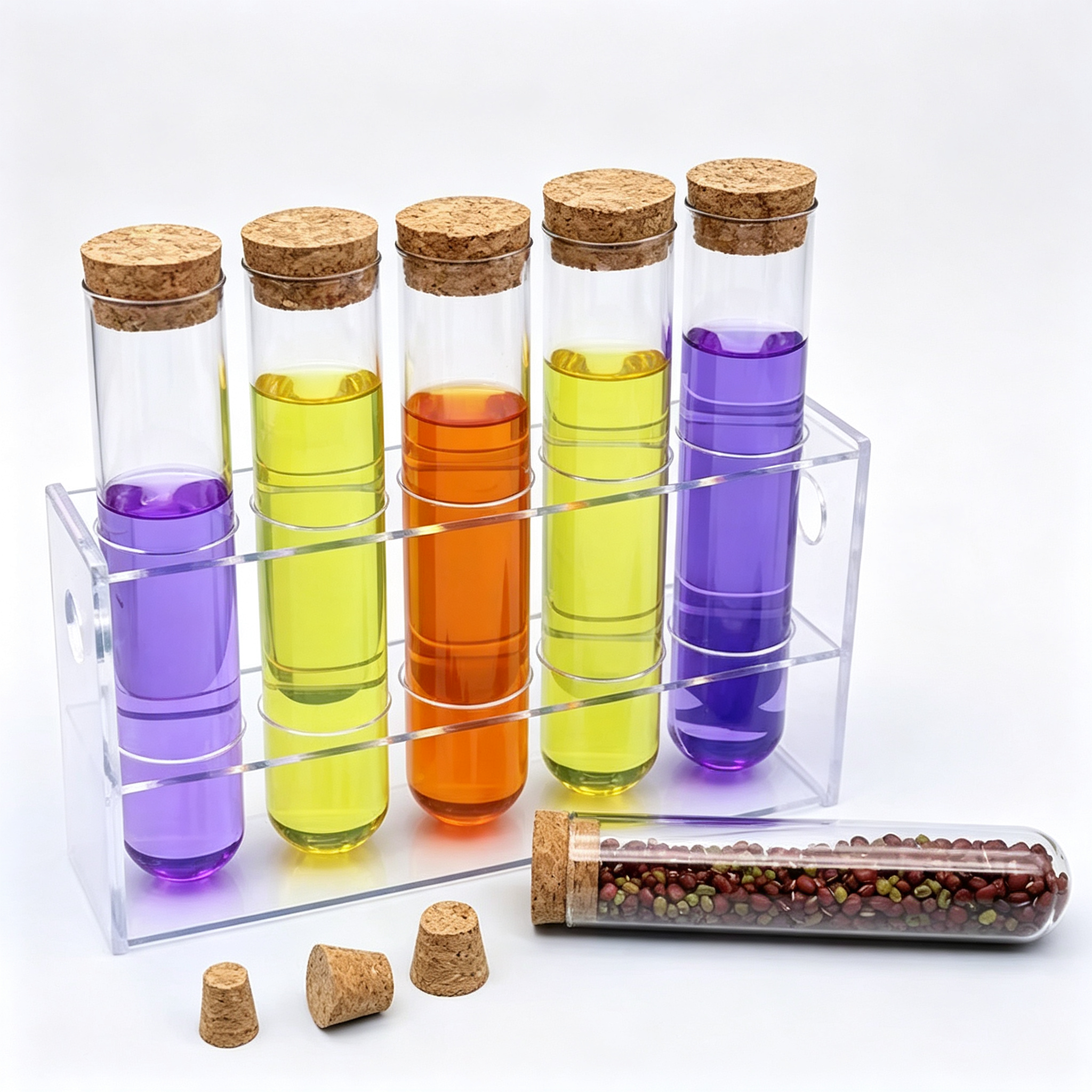
Glass Test Tube With Cork Stopper
Borosilicate Glass Test Tubes with Natural Cork Stoppers for Reliable Sample Handling
When you need a dependable vessel for mixing, heating, storing or transporting liquid and solid samples, a glass test tube with cork stopper remains one of the most practical choices in any laboratory. JSHD manufactures cork stopper glass test tubes from high-grade borosilicate glass, delivering the clarity, thermal resistance and chemical compatibility that researchers, educators and quality-control technicians rely on every day. Each tube is paired with a precision-sized natural cork stopper that creates a snug, breathable seal — ideal for cultures, specimens and short-term sample storage where a completely airtight closure is not required.
Why Choose Our Glass Tube Lab
Not all glass test tubes perform the same under real working conditions. Our cork stopper glass test tubes are produced from 3.3 borosilicate glass, which means they can withstand rapid temperature changes and direct flame heating without cracking — a critical feature for boiling, sterilization and water-bath procedures. The glass wall is uniformly thin enough for efficient heat transfer yet thick enough at the rim and rounded bottom to resist chipping during routine washing and autoclaving.
The natural cork stoppers supplied with each tube are cut from high-density cork bark, sized to match the tube's inner diameter within a tight tolerance. Cork offers a unique advantage over rubber or plastic stoppers: it is porous enough to allow gas exchange, making it suitable for microbial cultures and fermentation studies, while still preventing dust, airborne contaminants and sample spillage. The stoppers can be easily removed and reinserted, and they stand up to repeated autoclave cycles when handled correctly.
Specifications and Available Sizes
We offer our glass test tubes with cork stoppers in a range of standard dimensions to cover common laboratory volumes. Typical sizes include 12×75 mm, 13×100 mm, 15×150 mm, 18×180 mm and 20×200 mm, with custom lengths and diameters available for OEM and bulk orders. Wall thickness typically ranges from 0.8 mm to 1.2 mm depending on tube diameter, and the working temperature range is approximately -20°C to 500°C for short-duration heating. Every tube features a fire-polished rim, a rounded bottom and a clear, distortion-free wall that allows accurate visual inspection of color changes, precipitate formation and sample volume. The cork stoppers are supplied separately or pre-inserted according to your preference, and each stopper is graded for density and surface finish before packing.
For customers who need graduated markings, we can supply these tubes with permanent white ceramic graduations or amber enamel scale lines, resistant to autoclaving and common laboratory detergents. Printing of lot numbers, brand logos or custom measurement scales is also available on orders above the minimum printing quantity.
Common Applications
These versatile tubes are used across a wide range of settings. In research and clinical laboratories, they serve as culture tubes, mixing vessels and reaction containers. In schools and universities, they are a staple of chemistry and biology classrooms for demonstrations, titrations and student experiments. Industrial quality-control labs use them for sample preparation and visual comparison tests. They are also popular for craft and decorative uses, such as spice storage, candy packaging and wedding favors — though our manufacturing standard is built for laboratory-grade performance first.
Quality Control and Packaging
Every batch of JSHD cork stopper glass test tubes undergoes dimensional inspection, wall-thickness measurement and thermal-shock testing before shipment. Tubes are packed in corrugated cartons with molded pulp or PE dividers to prevent breakage during transit. For export orders, we can provide neutral packaging or custom-printed cartons with your brand logo. MOQ is flexible — contact our sales team for pricing on sample packs, standard cartons and full container loads.
Care and Usage Tips
To get the longest service life from your cork stopper glass test tubes, a few simple practices go a long way. Always inspect tubes for cracks or chips before heating, and never apply direct flame to an empty tube — pre-fill with liquid or use a water bath. When inserting the cork stopper, twist gently rather than pushing straight down; this reduces the risk of rim chipping and ensures a more consistent seal. Cork stoppers should be removed before autoclaving if a fully sealed vessel is not desired, as pressure buildup inside a tightly stoppered tube can cause breakage. After use, wash tubes with a non-abrasive brush and laboratory-grade detergent, rinse thoroughly with deionized water and dry upside down in a tube rack.
Ordering and Customization
Whether you need a few hundred tubes for a classroom semester or several hundred thousand for a distribution contract, JSHD can scale production to meet your volume. We support OEM branding, custom size tooling, mixed-size kits and private-label packaging. To request a detailed quotation, product samples or a current size catalog, send us an inquiry through the contact form or email our export team directly. We typically respond within one business day.

WHY CHOOSE US
Since its establishment, our factory has been developing first world
class products with adhering the principle
of quality first. Our products have gained excellent reputation in the industry and
valuabletrusty among new and old customers..
- Tel:86-515-88387981
- Qingfeng industrial park, yandong, yancheng, jiangsu, China
- sales@chinahuida.cn


Tips - Featured Products - Sitemap
Lab Microscope Slide, China Surgical Suture, Plastic Labware, Laboratory Glasswares, Microscope Slides, Laboratory Glassware, All Products