
Welcome To Huida
High-Quality Buchner Funnel
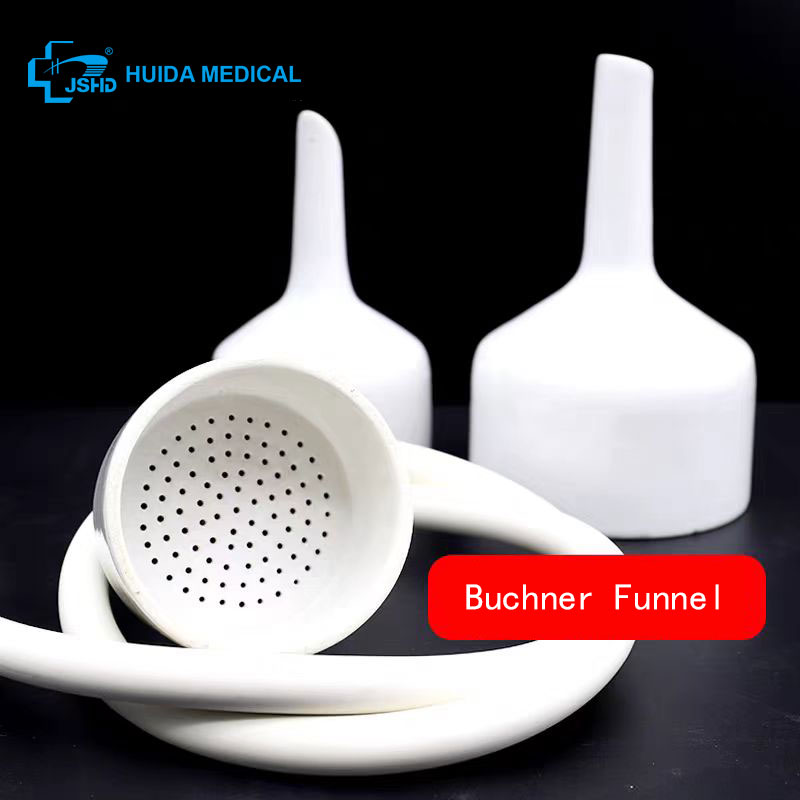
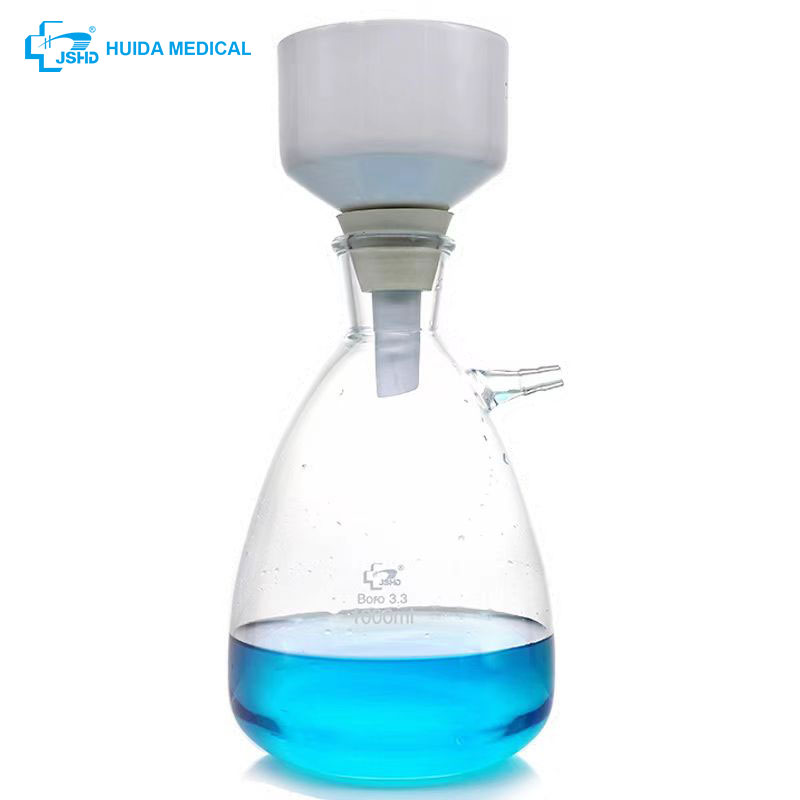
The Buchner funnel is an important laboratory filtration funnel widely used in vacuum-assisted solid-liquid separation in chemical synthesis, environmental analysis, drug testing, microbiology, and materials research. Its unique design enables researchers to perform rapid, reliable, and high-purity filtration, especially when used in conjunction with a vacuum source and a Buchner flask.
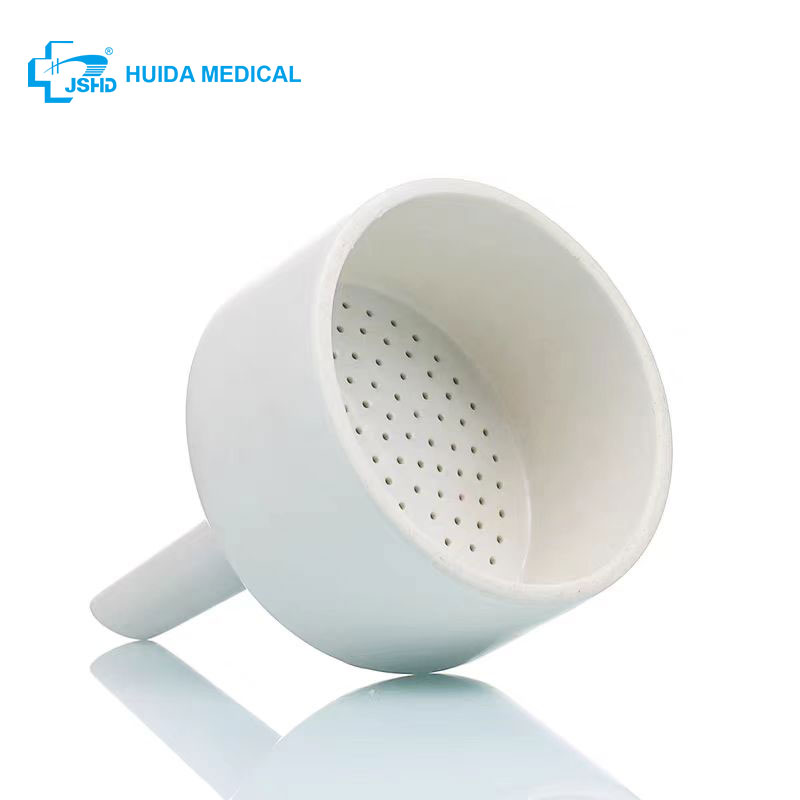
The Buchner funnel shown above is made of high-grade specialty ceramics, offering superior hardness, chemical resistance, and temperature stability compared to plastics or low-cost alternatives. The funnel features a wide, circular opening, a deep cylindrical chamber, and a flat, perforated plate at the bottom. These precision-drilled perforations support the filter paper, ensuring uniform liquid distribution during vacuum aspiration. This uniformity ensures efficient filtration, minimizes clogging, reduces turbulence, and improves the transparency of the filtrate.
The funnel stem features a smooth, rounded outlet design, forming a stable seal when connected to various vacuum filtration flasks or systems. The entire funnel surface is glazed and polished, making it smooth, easy to clean, and durable, preventing residue buildup.
Features of the Buchner Funnel
● High-Strength Specialty Ceramic – Durable and Long-Lasting
Unlike plastic funnels that age over time, ceramic funnels remain stable even under harsh conditions. They resist the corrosive effects of acids, alkalis, and solvents, ensuring a long service life and consistent performance.
● Smooth Glazed Surface for Easy Cleaning
Both the inner and outer surfaces are uniformly polished. This prevents chemical residue adhesion, reduces cleaning time, and improves efficiency and hygiene during repeated use.
● Precision Perforated Plate for Uniform Suction
Evenly distributed perforations on the flat base support the filter paper without tearing. This ensures optimal suction, stable filtration speed, and minimal particle displacement.
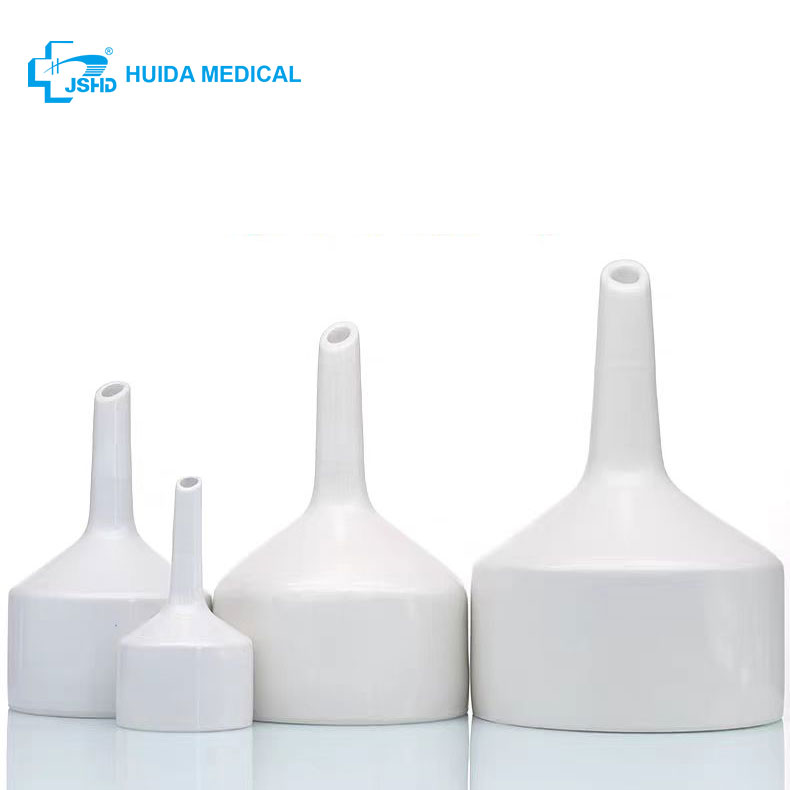
● Wide Size Range to Meet Flexible Laboratory Application Needs
The product range, from 60 mm to 300 mm, caters to various laboratory capacity requirements—from small-scale analytical filtration to high-volume preparation.
● High Compatibility with Vacuum Filtration Systems
The funnel's circular outlet fits perfectly with standard vacuum bottles, filter adapters, and rubber stoppers. This compatibility simplifies installation and reduces the risk of leakage.
● Heat-, Pressure-, and Chemically Resistant
The ceramic material maintains structural stability during high-temperature drying, repeated sterilization, and continuous vacuum filtration, making it ideal for harsh laboratory environments.
Specification Of Filter Funnel
Specification | Diameter (mm) | Weight (g) |
60 mm | 60 | 114 |
100 mm | 100 | 325 |
120 mm | 120 | 562 |
150 mm | 150 | 1006 |
200 mm | 200 | 2049 |
250 mm | 250 | 3361 |
300 mm | 300 | 5381 |
Applications of Buchner Funnels
● Chemical Analysis and Organic Synthesis
Excellent for removing solid catalysts, purifying reaction mixtures, and separating precipitates.
● Pharmaceutical Quality Control
Used for sample pretreatment in the purification of active pharmaceutical ingredients, testing of excipients, and instrumental analysis.
● Environmental Monitoring Laboratories
Suitable for filtering soil suspensions, particulate matter, wastewater samples, and extracts.
● Microbiology and Life Sciences
Commonly used for filtering culture media, separating biomolecules, and clarifying biological solutions.
● Food and Beverage Testing Laboratories
Used for filtering extracts, additives, and analytical test samples.
● Educational and Research Institutions
Excellent for teaching vacuum filtration principles and conducting routine laboratory training.
Why Choose Jiangsu Huida's Buchner Funnels?
Jiangsu Huida is a globally renowned manufacturer with over 20 years of experience in producing laboratory consumables. Our ceramic Buchner funnels are manufactured in a standardized factory equipped with advanced molding, firing, and quality inspection systems. Each funnel undergoes rigorous dimensional and performance testing to ensure consistent quality, uniform perforation accuracy, and robust construction.
With ISO9001, ISO13485, CE, and FDA certifications, our products are trusted by laboratories in Europe, the United States, and Southeast Asia. Huida employs modern ERP and MES systems for full traceability and quality control of each production batch. Our priority is on accuracy, stability, and long-term reliability, making our ceramic Buchner funnels ideal for demanding laboratory filtration tasks.
翻译结果
翻译结果
Frequently Asked Questions about Buchner Funnels for Laboratory Filtration
1. Which type of filter paper should I use with a ceramic Buchner funnel?
Please use high-quality qualitative or quantitative filter paper that matches the funnel diameter. Ensure the filter paper is laid flat on a perforated plate to maximize filtration efficiency and prevent leakage.
2. Can ceramic Buchner funnels withstand high temperatures?
Yes. Ceramic materials are heat-resistant and can be used to hold hot liquids and in drying ovens. This makes them suitable for sterilization and processes involving temperature changes.
3. How can I prevent leakage during vacuum filtration?
Ensure the funnel handle is tightly connected to the rubber filter adapter or stopper. A tight seal between the funnel and the vacuum bottle is essential to maintaining strong vacuum suction.

WHY CHOOSE US
Since its establishment, our factory has been developing first world
class products with adhering the principle
of quality first. Our products have gained excellent reputation in the industry and
valuabletrusty among new and old customers..
- Tel:86-515-88387981
- Qingfeng industrial park, yandong, yancheng, jiangsu, China
- sales@chinahuida.cn


Tips - Featured Products - Sitemap
Lab Microscope Slide, China Surgical Suture, Plastic Labware, Laboratory Glasswares, Microscope Slides, Laboratory Glassware, All Products